In a diamond-shaped area surrounded by Fenyang Road, Yueyang Road, Dongping Road, Hengshan Road, Baoqing Road, and Middle Huaihai Road, the Hengfu Music District is formed. It is a vibrant neighborhood in Shanghai with outstanding historical buildings such as Nie Er's former residence and Yuan Xuefen's former residence, as well as professional institutions like the Shanghai Conservatory of Music and the Shanghai Symphony Orchestra. It is the most culturally rich music district, the most concentrated hub of musical talent, and the most densely populated area of music performance institutions in the city. In 2021, the Hengfu Music District was recognized as one of the first national-level nighttime cultural and tourism consumption clusters. Among them, the building affectionately known as the "Wonton Wrapper" by the locals is the Shanghai Symphony Hall.
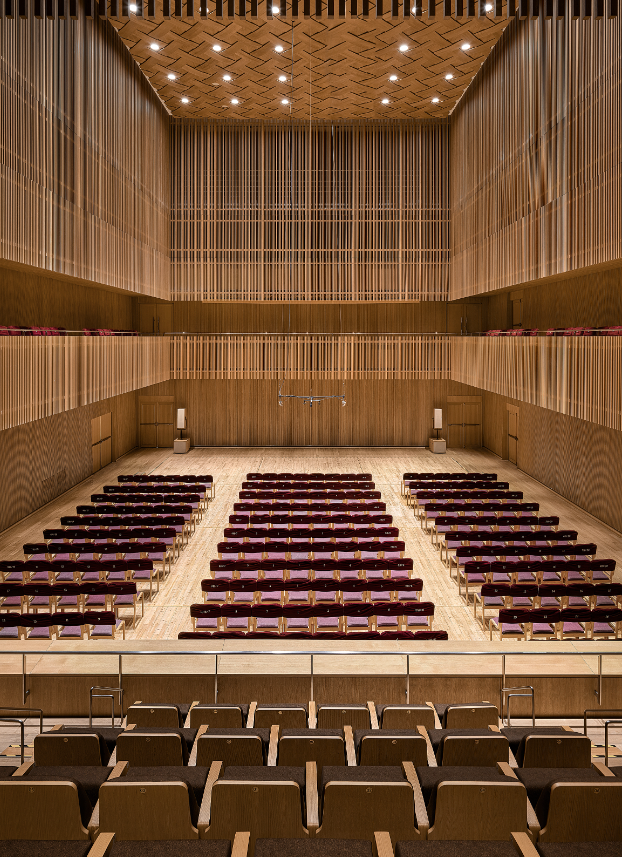
In 2014, the Shanghai Symphony Hall opened its doors. With its saddle-shaped exterior and four-color mixed wall tiles, it is the first "fully floating" concert hall in China. Among the construction of the theater, the concert hall is the most complex. In addition to the functions of a typical theater, the concert hall has particularly high requirements for sound effects. To avoid the vibrations from the nearby Line 10 subway, which is only 6 meters away, the entire concert hall is "suspended" on 168 cement piers and 300 isolators.
The completion of the Shanghai Symphony Hall marks a new chapter for the Shanghai Symphony Orchestra in their "home", where the concert hall and the orchestra are united. However, the Shanghai Symphony Orchestra is much older than the Shanghai Symphony Hall. The predecessor of the Shanghai Symphony Orchestra was the Shanghai Public Band, established in 1879, and it has now passed through 145 years. As the oldest symphony orchestra in Asia, the Shanghai Symphony Orchestra not only introduced Western music extensively at an early stage, performed Chinese orchestral works, trained Chinese musicians, and cultivated an audience for symphonic music in China, but also, in the ups and downs of the three centuries, has always upheld an international perspective and a cosmopolitan spirit, gradually growing into a world-class orchestra that brings together top musicians from around the world and best represents the interpretive ability of Chinese music.
Symphonic music is the language of the world and does not require translation. It is one of the best languages to tell Chinese stories. In the past decade, 2,696 performances have taken place on this fertile ground of music, attracting over 1.5 million audiences. The accumulation of time has allowed the concert hall's sound quality to reach an excellent state, making it a benchmark and a role model in the industry.



















 2026-05-28