"Xinchang Ancient Town is an important carrier that embodies the formation and development of ancient Shanghai; it is a microcosm of the evolution of traditional towns in modern Shanghai; it is a true picture of the lives of the indigenous people of Shanghai," said Professor Ruan Yisan, an expert in town preservation.
Located on the east bank of the Pudong River in Shanghai, Xinchang Ancient Town is the southern gateway of Pudong New Area. It is bordered to the north by Zhangjiang Science City and to the south by the Free Trade Zone in Lingang New Area. It emerged in the mid-Tang Dynasty and has a history of nearly 1300 years. It is a city water town that integrates red culture, Shanghai style culture, and Jiangnan culture. In 2005, the Shanghai Municipal Government approved Xinchang Town as one of the first historical and cultural preservation areas in Shanghai. In 2008, Xinchang Ancient Town was named "China Historical and Cultural Famous Town." Since 2019, Xinchang Ancient Town, as the sole representative of Shanghai, together with 10 other water towns in Jiangnan, Jiangsu, and Zhejiang, jointly applied for the "Jiangnan Water Towns Project" as a World Natural and Cultural Heritage.
Xinchang Ancient Town has a history of over 800 years since its establishment. Its name comes from the migration of the salt fields of Xiasha in the Southern Song Dynasty, forming new salt fields. Since the Tang and Song Dynasties, Xiasha has been a famous salt field along the East China Sea coast. With the extension of the land to the southeast, the salt field also migrated. In the Yuan Dynasty, the Salt Transportation Office of Zhejiang and Zhejiang Salt District moved its branch office to this area. People then referred to the original salt field as the "old field" and called this place the "new field," which has been inherited as its present name.
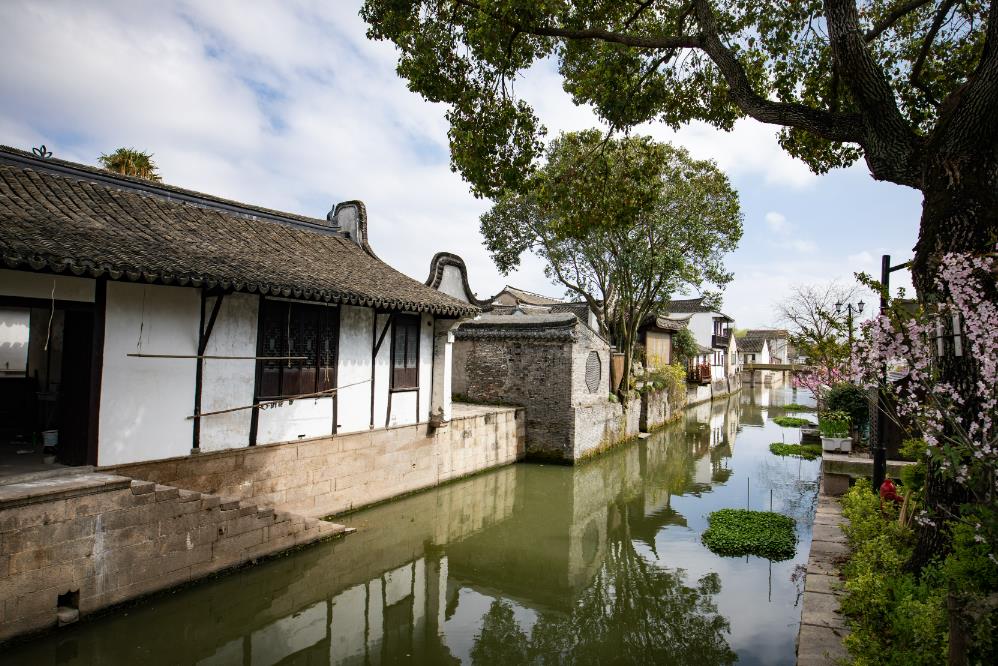
Currently, the total building volume of the protected area of the ancient town is about 350,000 square meters. Among them, there are nearly 150,000 square meters of historical buildings from the late Qing Dynasty to the early Republic of China, several old streets over 2,000 meters in total length, 1,200 meters of Ming-Qing canal stone revetment, 69 ancient ceremonial gates, 4 "tic-tac-toe" shaped canals, and 17 horse-saddle-shaped water bridges. There are also 59 municipal and district-level cultural preservation units (sites). The preservation rate of buildings from the Ming, Qing, and Republican periods is over 55%. Ancient streets, archways, houses, ceremonial gates, bridges, stone revetments, temples, and ginkgo trees everywhere present the historical charm of the "eight antiquities." The town is traversed by the Shihe River, adorned with delicately carved stone bridges, surrounded by waterfront houses, with stone revetments extending along the river, and horse-saddle-shaped water bridges lining the walls, fully displaying the water town style that has earned it the reputation of "Small Town Competing with Suzhou."



















 2026-05-28