Shanghai Secrets is a column devoted to the city's most elusive treasures – the tucked-away spots, under-the-radar experiences, and word-of-mouth wonders that even longtime locals might not know. From clandestine cocktail bars and unmarked dumpling dens to artisans and ateliers hidden in plain sight, we curate Shanghai's best-kept secrets. If you have to know someone to find it, you'll find it here.
A Massive Surprise Find to Get Gifts... (Or Treats for Yourself)
The China International Import Expo opened this week. This is the ninth one. For six days, through November 10, the National Exhibition and Convention Center out in Hongqiao fills up with 162 countries, regions and international organizations and 4,142 overseas companies, all of them trying to sell something to China.
That is the whole idea. CIIE has been run by the Ministry of Commerce and the Shanghai government since 2018, and it is the rare trade fair where the rest of the world does the pitching and China does the shopping. The public gets three of those six days, November 8 to 10. A single-day pass costs 50 yuan and only works on the date printed on it. If you have the opportunity to go, it is an experience unlike anything else on the planet. We did an inside look on the US, Australian, and UK Pavilions two years ago.
Then the booths come down. So where does the Uzbek lacquer box go on November 11?
The fifth floor of Global Harbor, it turns out. We sort of stumbled onto this place by accident while working on another piece covering the entire rooftop of the mall, and boy did we stumble into something verrrrry practical, dare we say... neat.
What you are about to behold... is one of the city's best-kept secrets for finding gifts from literally all over the world.
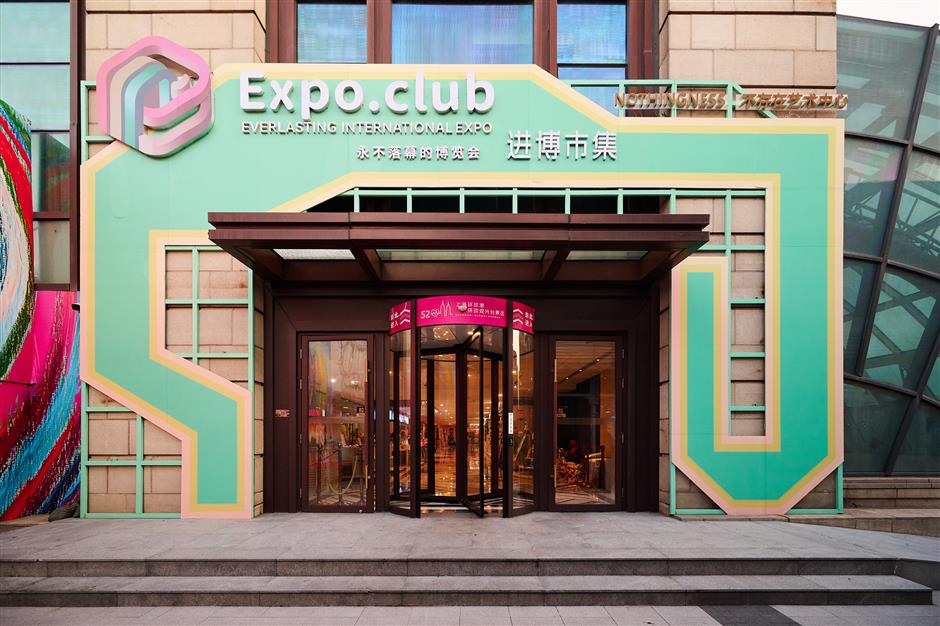
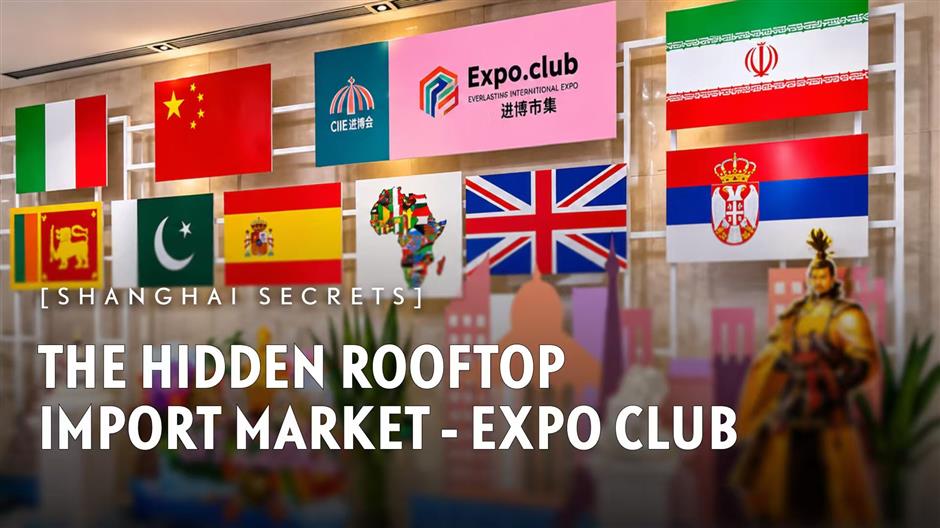
Expo.club, fifth floor, Global Harbor. Teal, pink, and a revolving door. It looks like a friendly spaceship, but it sells biscuits.
So What Is It?
This is Expo.club. In Chinese, it is jin bo shi ji, which roughly means "CIIE market." The sign over the door calls it the "Everlasting International Expo," which is a lot of signs for a shop. It is run by Yuexing Group (月星集团), the same company that built Global Harbor itself, a 480,000-square-meter mall that opened on Zhongshan Rd N. in 2013. This just happens to be the largest mall in Shanghai at the moment, and we'll be doing a separate piece on that later.
The shop is part of Shanghai's "6 days + 365 days" program, which is the city's way of saying that six days of exhibits should turn into a year of merchandise. It opened during the 2024 expo and covers about 2,000 square meters. By the end of last year's CIIE, it carried more than 2,300 products from over 30 countries, 423 of them brought in during that single expo week.
That was last year's count, and the shop's manager says it is out of date. The "30-plus" figure covered only the core countries that are always on the shelves and have settled supply chains. After a year of rotating stock, several country-themed pop-ups and a scramble to line up this expo's new exhibitors, the shop now carries or holds in reserve goods from more than 40 countries and regions. That works out to roughly 2,600 to 2,800 SKUs, of which about 450 to 500 will be new from this expo.
Sun Haoyang, the manager, is not chasing a bigger number. "Frankly, we don't blindly pursue the vanity number of how many flags we've hung," he says. The biggest lesson of running a physical market is that when a country's goods sit for months with nobody asking about them, the shop is left holding the inventory and the cash-flow problem. "Every country we keep needs something solid to show for itself, and has to earn repeat buyers in the Shanghai market." Going deep on 40-odd supply chains is worth more, the Xiao says, than inflating the count.
The same logic applies to products. Plenty of other shops try to stack up 3,000 or 4,000 items, or more. After last year, he says, this shop did something decisive: "dynamic elimination, precise new arrivals." The shelves are therefore curated.
How Are The Products Sourced Tho?
Broadly, the shop mixes three methods: Expo Club buyers picking items on site at the expo, working directly with exhibitors at the source, and using licensed port channels to handle the import side. Plenty of things can derail a product along the way, so the shop tries to work with as many suppliers as it can and stays open to other arrangements.
The layout is simple. Each country gets a corner, a flag and a sign. You can walk from Mongolia to Argentina without the 2,000 sq m space.
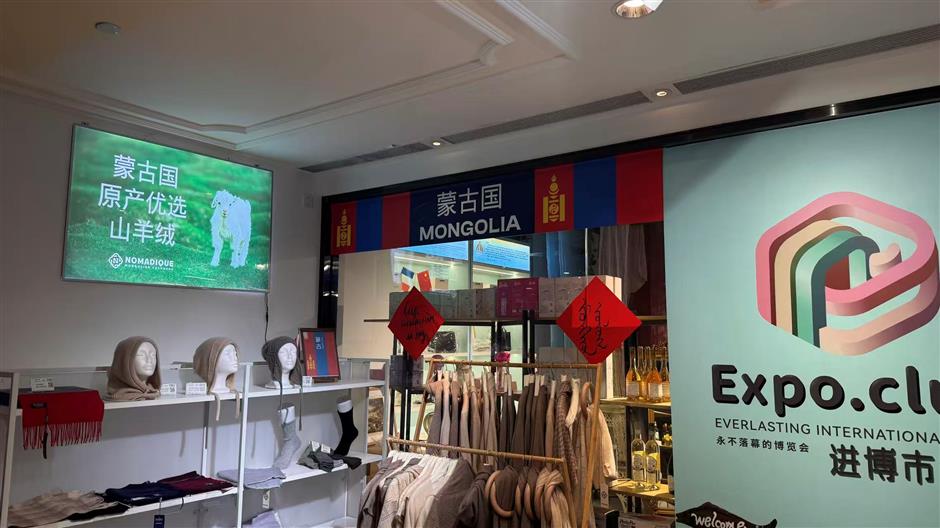
First thing you see is the logo. Second thing is the cashmere. Priorities.
Mongolia leads with cashmere: a rack of sweaters and cardigans in every shade between oatmeal and camel. The red diamond on the left of the window is a Lunar New Year greeting in Cyrillic Mongolian. The one on the right is in traditional Mongolian script, which runs top to bottom.
Buy a scarf for anyone who complains about Shanghai winters. Which, usually... is everyone.
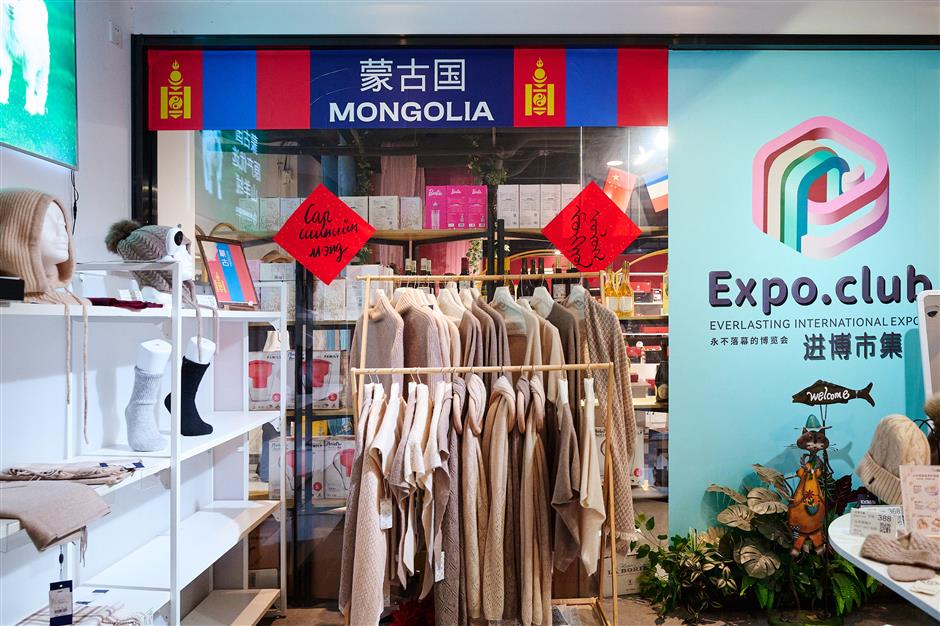
Cashmere in every shade between oatmeal and camel, under two red Lunar New Year diamonds. Buy one for anyone who whines about Shanghai winters. (That's everyone.)
Argentina is mostly about yerba mate. Playadito, made by a farming cooperative in Colonia Liebig in Corrientes province, became the best-selling yerba in Argentina in 2025, at 56.7 million kilos for the year. It has been exporting to China since 2015. A bag here is 39.8rmb.
There is also a Messi-themed mate gourd set, with a big number 10 and "Dream With Us" on the box, for 398rmb (a smaller one is 328rmb). Another Playadito box has Che Guevara on the front, sipping mate through a bombilla, the metal filter straw. That one is 218rmb.
If you know an Argentine, you already know the gift.
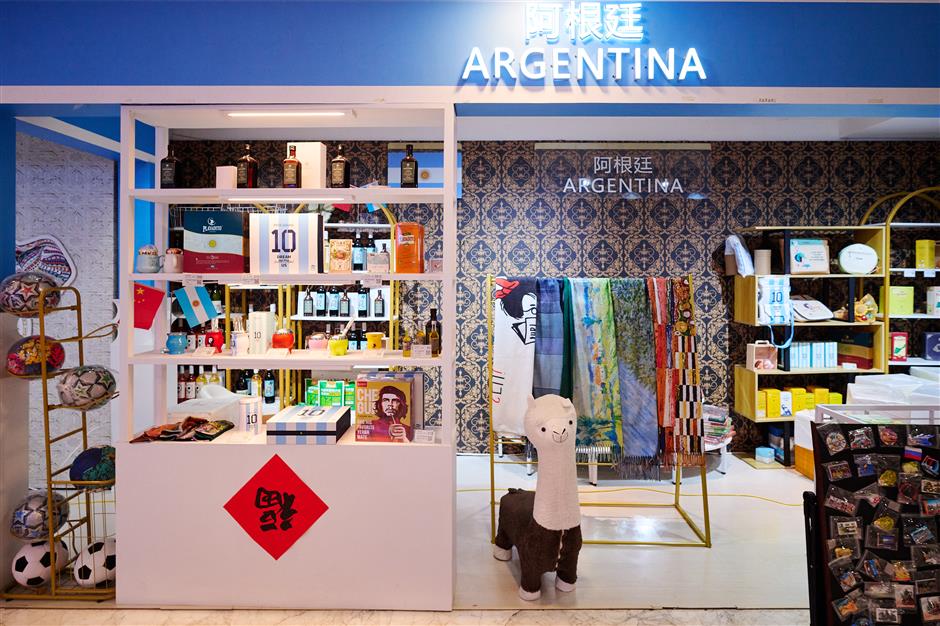
Flags, soccer balls, a llama (I think?) and a wall of yerba mate. A bag is 39.8 yuan. The Messi gourd set is 398 yuan. Buy the gourd.
Georgia gets wine racks along one wall and a table of leather bags along the other. After last year's expo, the shop brought in a line from Georgia that pairs fine cowhide with walnut wood. Up front are enamel brooches from a maker called COSMO, 66 yuan each, which makes them about the cheapest handmade thing in the room and also some of the best.
Now... Georgian wines... ahhhh.... they are sooooo good. I have no idea why they aren't more popular. These wines are special for a combination of deep historical roots, a unique ancient winemaking method, and a remarkable diversity of native grapes. They are considered by many to be the "cradle of wine," with an 8,000-year-old uninterrupted tradition.
The Samaia semi-sweet red comes from the Alazani Valley in Kakheti, Georgia's main wine region. Semi-sweet reds are a Georgian specialty, and an easy one to hand to someone who says they "don't really drink wine." When they take a sip, they'll know you love them. It's a potion of sorts, I swear.
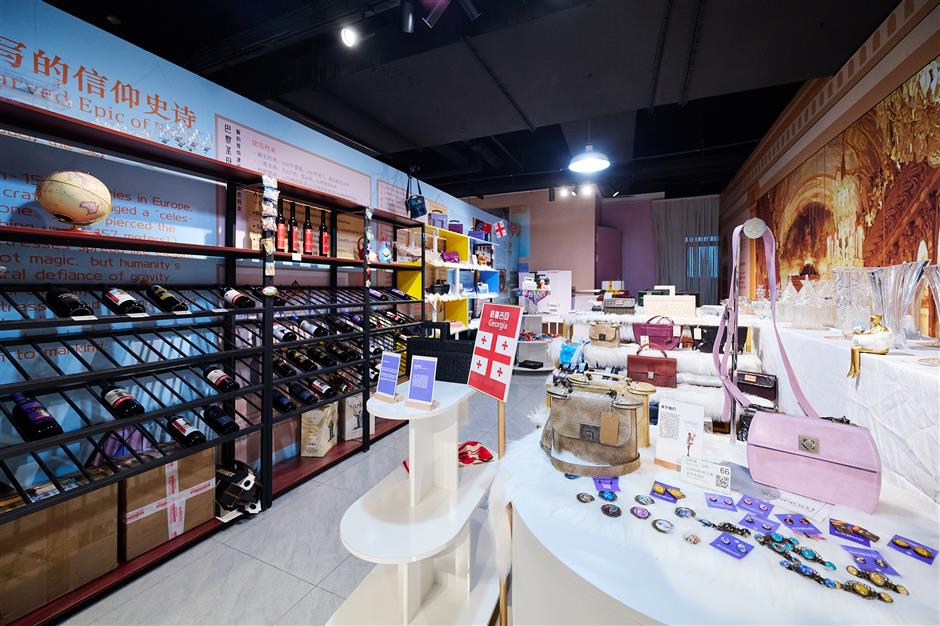
Wine on one wall, leather on the other, and a table of tiny enamel brooches that are somehow the best things in the room.
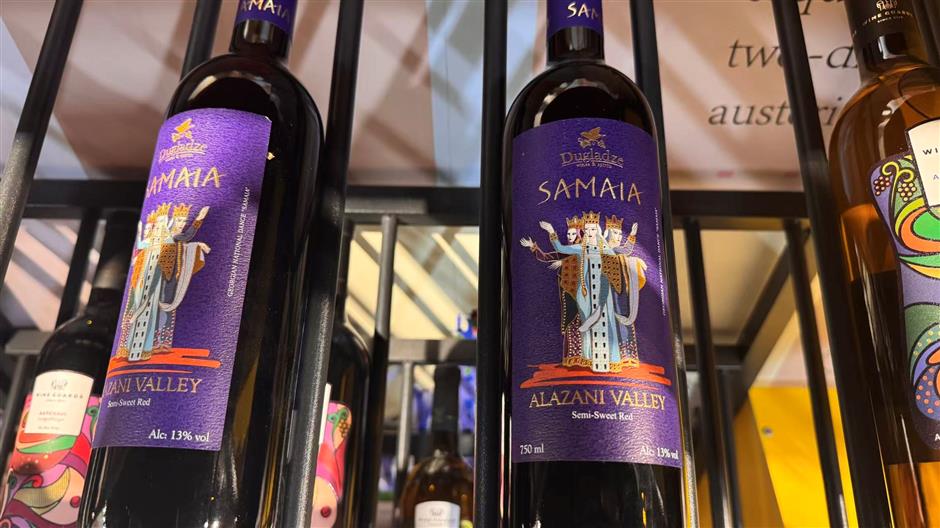
Samaia semi-sweet red from the Alazani Valley. Georgia has had about 8,000 years to practice. Hand it to the friend who "doesn't really drink wine."
Uzbekistan is the corner I would send most gift shoppers to. The round lacquer boxes are hand-painted, many with miniature portraits on the lids, and the framed miniature paintings beside them come out of the same tradition. There are malachite-green boxes, a carved wooden plate the size of a hubcap and a green ceramic teapot laid out in its own presentation case like a piece of jewelry. Several of the lacquer boxes, trays and copper plates were designed by an Uzbek painter and came straight over after the 2025 expo.
A painted box is a wedding gift that does not look like it came from a mall. It did. Hey, nobody needs to know.
There is a less breezy story behind one of those boxes. The manager says an Uzbek artist was in Shanghai in May for an exhibition, and the two of them met. He asked whether the shop could return a hand-painted lacquer box to her. Her father had painted it before he died, and her mother had asked her to come back to China and try to find it. The shop agreed. "To a customer it may look like an exotic handicraft," the manager says. But for the artists, it is an artisanal heirloom, one made by a beloved family member. We respect that."
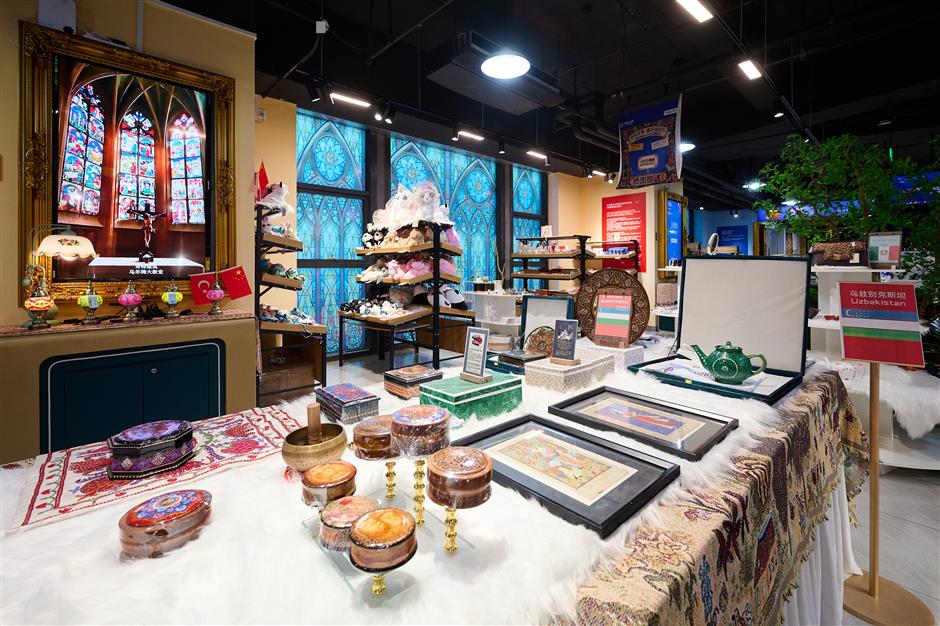
Hand-painted lacquer boxes with tiny portraits on the lids, plus framed miniatures from the same tradition. A wedding gift that does not look like it came from a mall. It did.
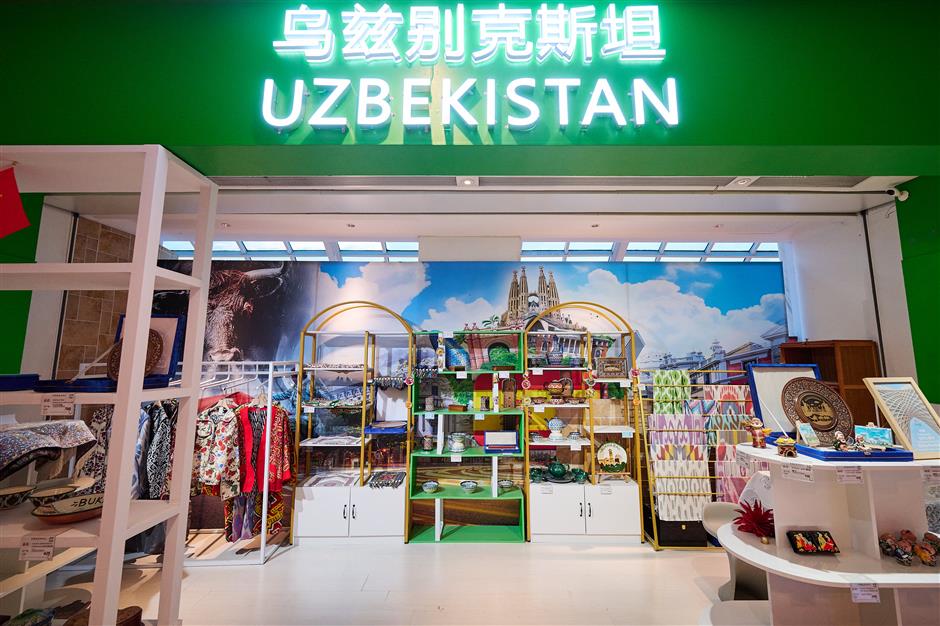
Welcome to Uzbekistan. Keep walking; there's more.
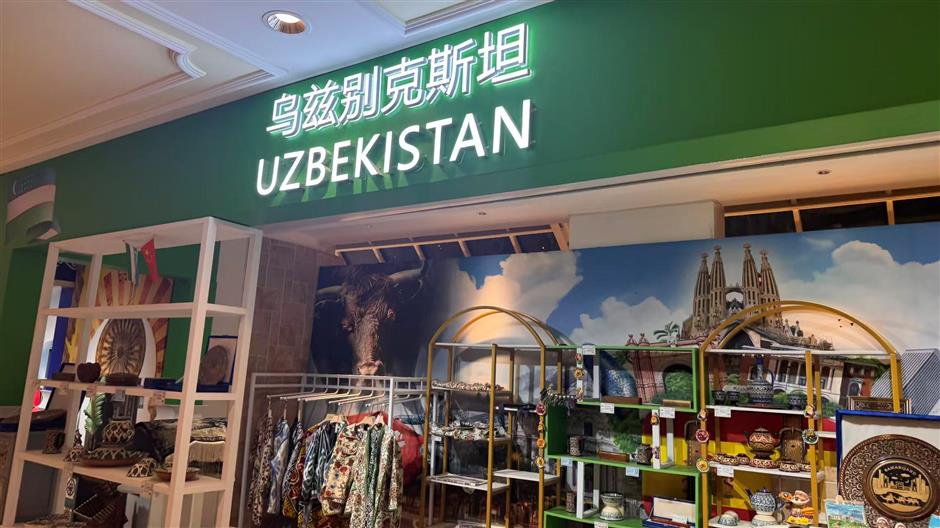
The whole corner: painted backdrop, racks of fabric, shelves of loud green things. Send your gift shoppers here.
Namibia is one display, and the display is a clutch. Snakeskin flap, chain strap, perched on a white fur throw like it pays rent here.
Skip it if the recipient is vegan. Buy it if the recipient is your aunt.
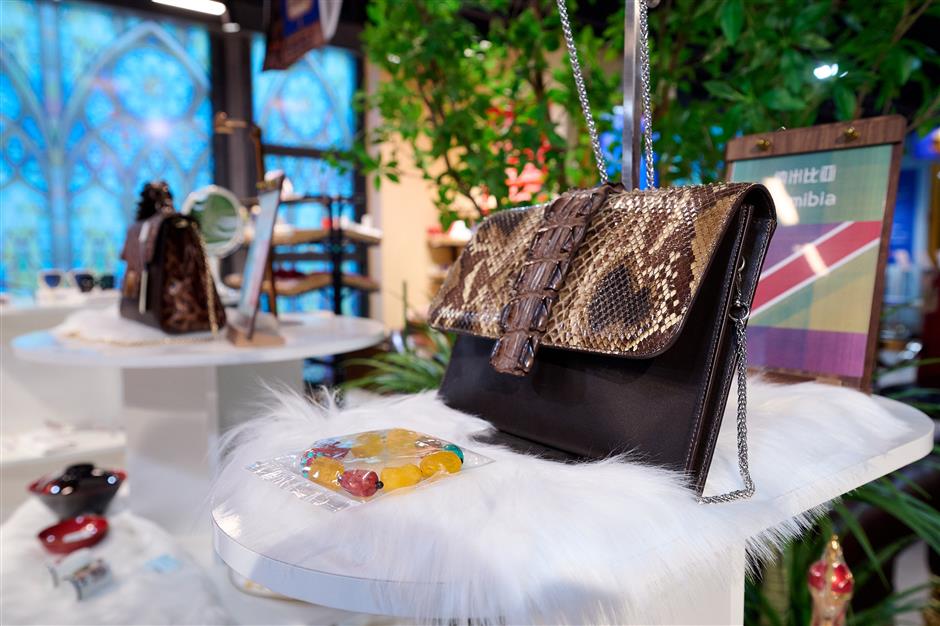
A snakeskin clutch on a white fur throw, like it pays rent here. Skip it for vegans. Buy it for your aunt.
Russia does two things well here. The first is Gzhel porcelain, the cobalt-on-white tableware named after a village about 50 kilometers southeast of Moscow, where it has been hand-painted for...oh... a couple of centuries. A lidded Gzhel tureen is 300 yuan. A black-and-gold sugar bowl in the same family is 494 yuan.
The second is wafers, in big blue bags, the size you buy when you are responsible for an office.
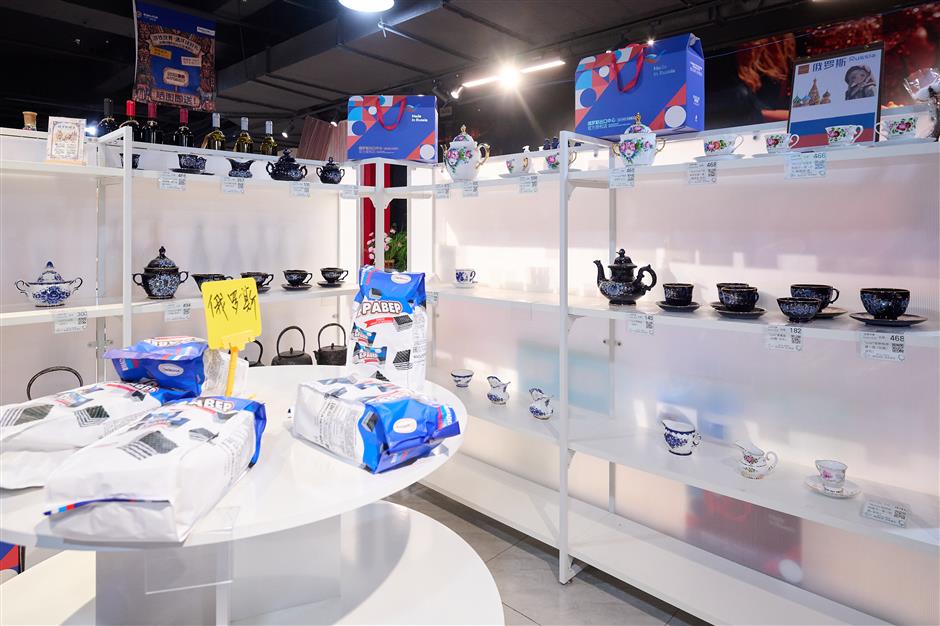
Gzhel porcelain on the shelves, blue wafer bags below. The wafers come in the size you buy when you're responsible for an office.
Serbia has the best snack table in the store. Domaćica, from Banini in Kikinda, is a 230g box of tea biscuits half-dipped in cocoa, the kind that lives in every Balkan grandmother's cupboard (I have no data on this, but I would bet on it). Tak are salty, flaky crackers from Jaffa of Crvenka, the company best known for its own version of Jaffa Cakes. The two brands have been under one roof since Jaffa bought Banini in 2017.
Behind them is the wine. A Trivanović white is 330 yuan. A Zdrebac Belo is 188 yuan. Raspberry rakia, from a label called Rakia Bar, is 298 yuan in a bottle shaped like a lab flask. Serbia is one of the world's biggest raspberry growers. This is one of the places the raspberries end up.
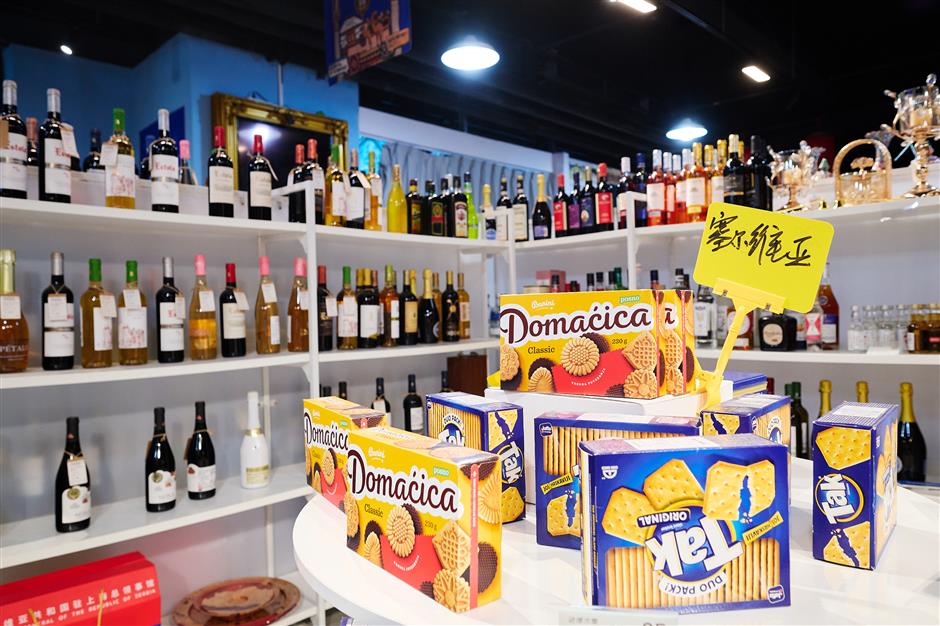
The best snack table in the building. That's Domaćica: tea biscuits half-dipped in cocoa, in a 230g box.
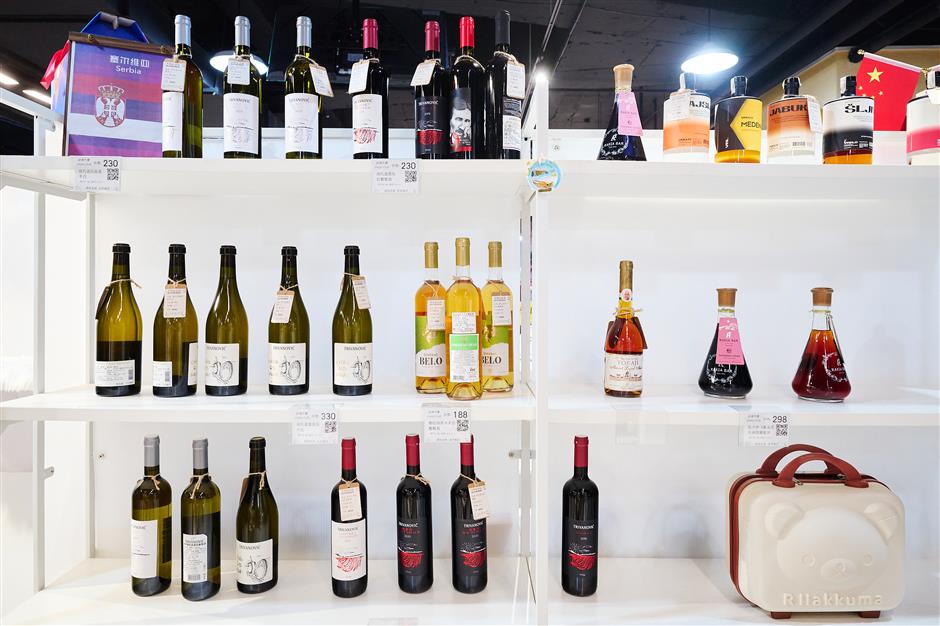
Serbian wine and a raspberry rakia in a bottle shaped like a lab flask. 298 yuan. Serbia grows a lot of raspberries. Some of them end up here.
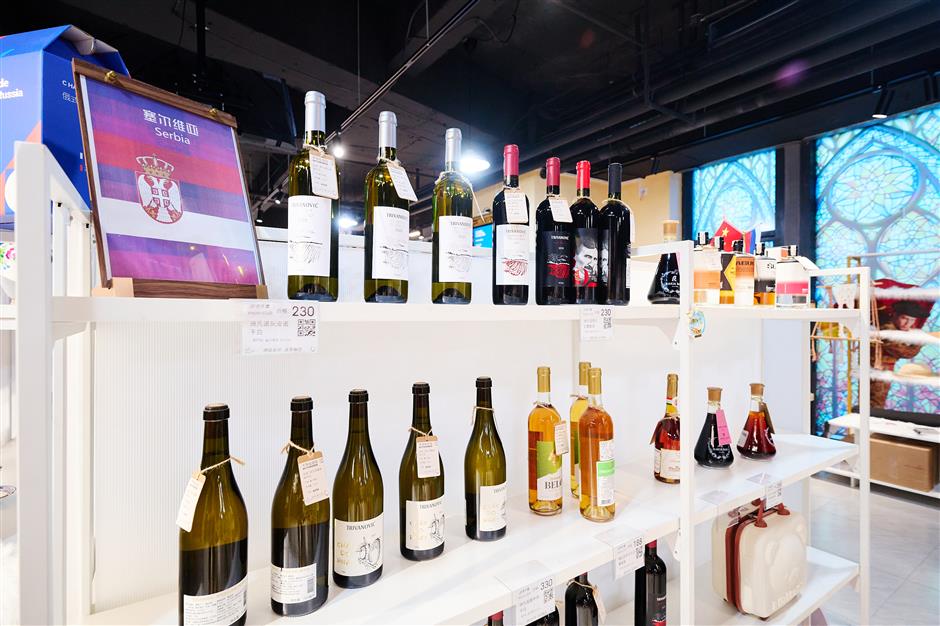
More wine. A Trivanović white is 330 yuan; a Zdrebac Belo is 188 yuan. Do the math on your next dinner party.
Syria brings soap. Aleppo soap is olive oil and laurel berry oil, boiled, poured, cut into blocks and aged for six months to a year, until the outside turns golden brown and the inside stays green. Here it comes in velvet gift boxes stamped "Amour éternel," which is French and means love eternal.
It is also the most useful gift in this article.
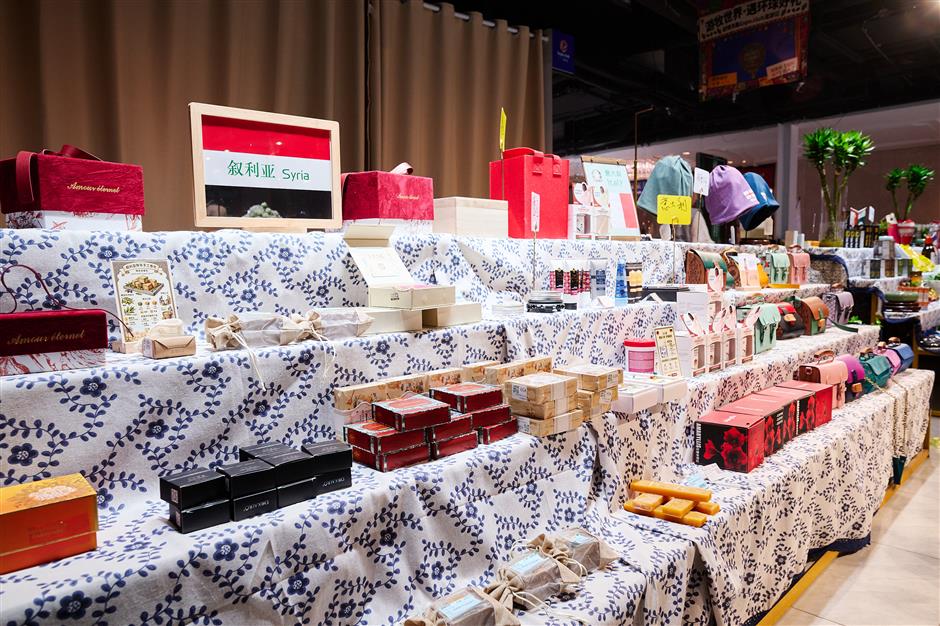
Aleppo soap in velvet gift boxes. Olive oil, laurel berry oil, six months to a year of aging. The most useful gift in this article.
Past Syria, the room turns red and gold. The rug corner hangs Persian-style carpets floor to ceiling, one of them curved overhead like the inside of a dome, which is a good trick for a mall.
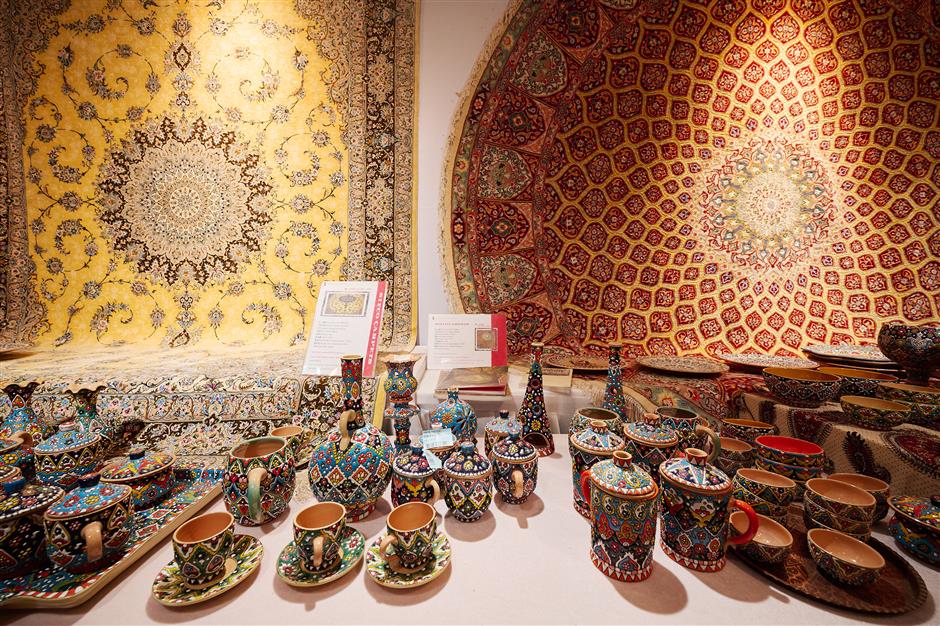
The room turns red and gold. Persian-style carpets hang floor to ceiling above a table of hand-painted ceramics. Subtle it is not.
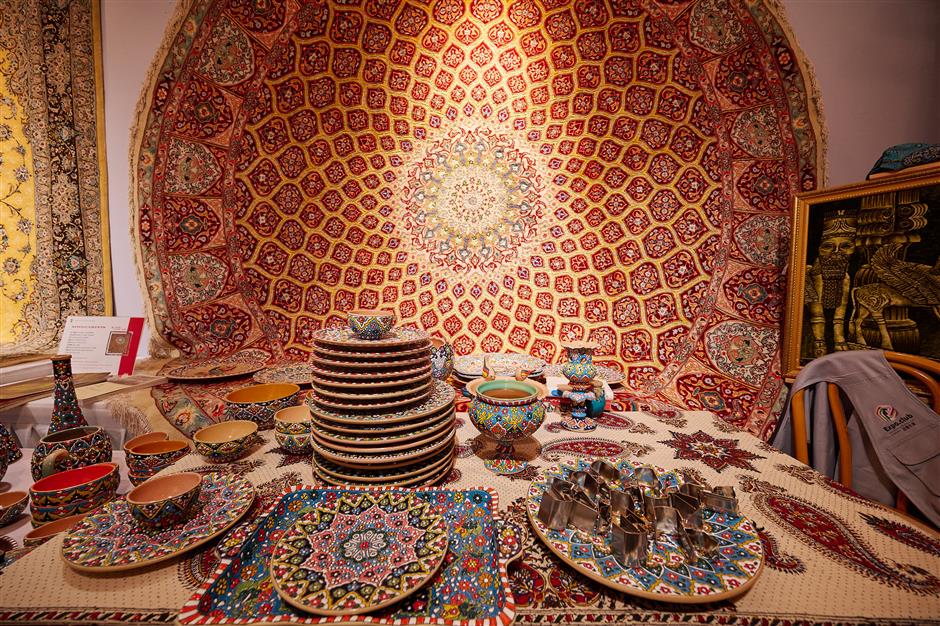
A round rug curved up the wall like the inside of a dome. A good trick for a mall.
Up close, the knotting is tight, and the colors are loud. Next to the rugs sits a small working loom, a few balls of colored yarn hanging off the frame, and a strip of pattern started along the bottom. It is there to show you how slow the work is. One knot at a time. It is very slow.
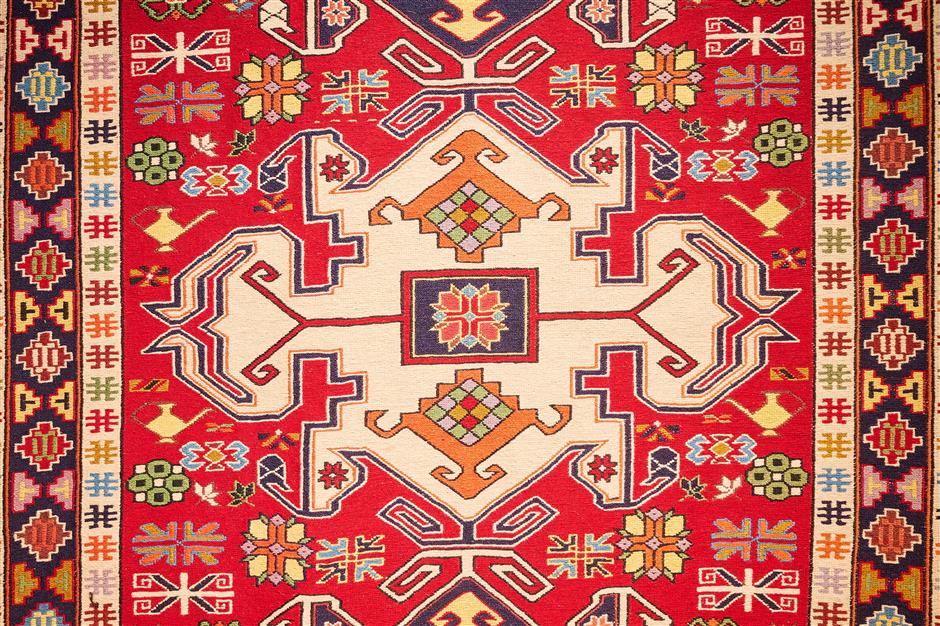
Up close the knotting is tight and the colors are loud. One knot at a time. It's very slow.
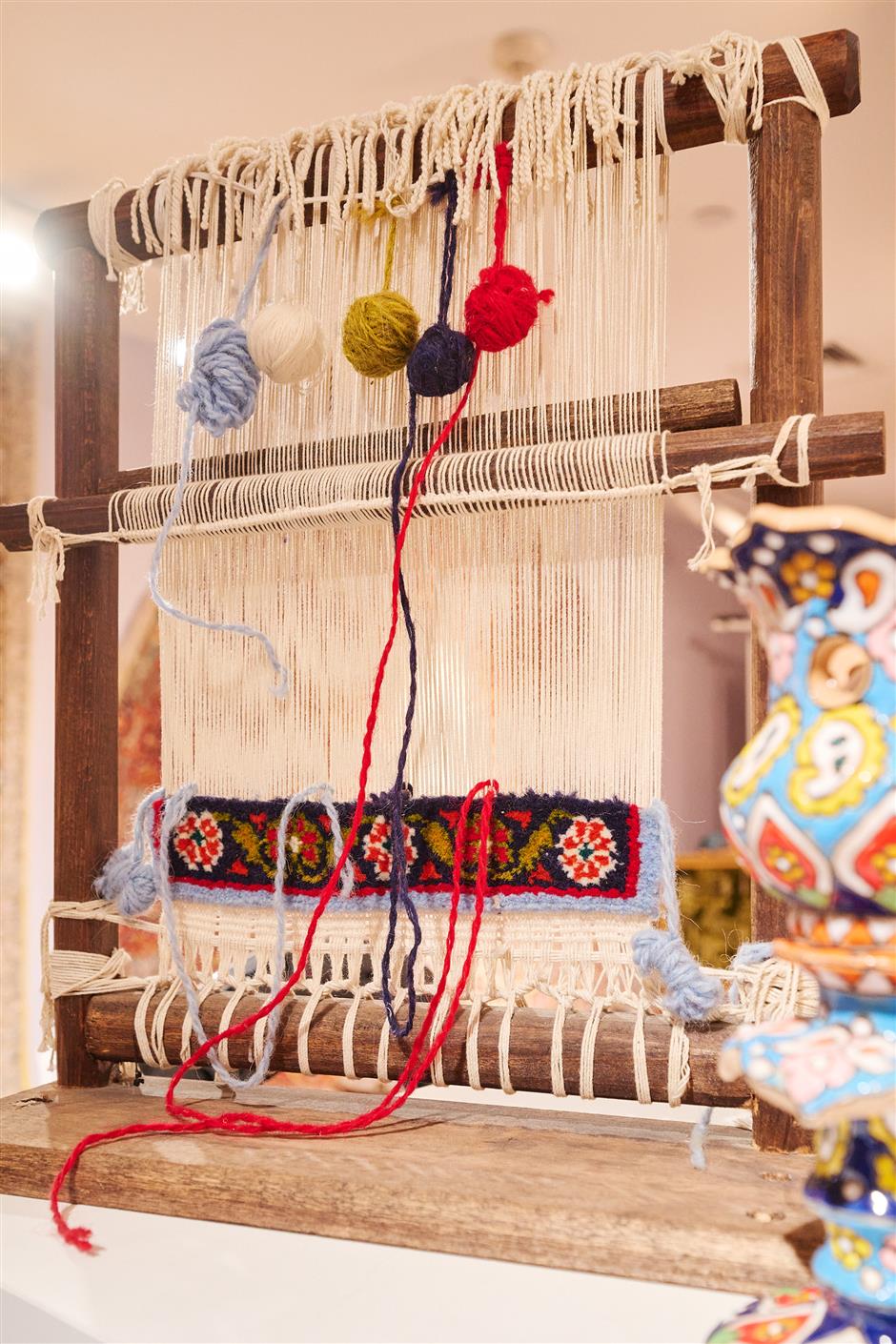
A small working loom, a few balls of yarn and a strip of pattern started at the bottom. It's here to show you how slow all this is. Respect.
Below the rugs are hand-painted ceramics: mugs, plates, vases and lidded jars, covered edge to edge in raised dots of color. One plate says "love" in the middle. Another has a peacock. These are the things of greatest spectacle here, and they would make a very good housewarming present for someone with a very white apartment.
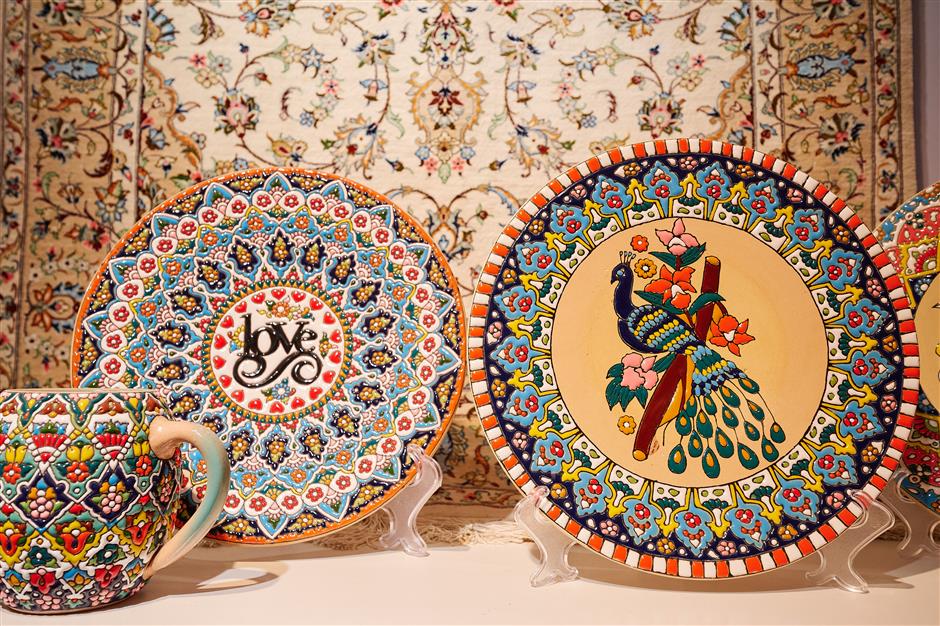
Raised dots of color on every surface. One plate says "love." The other has a peacock. They are the loudest things in a loud room.
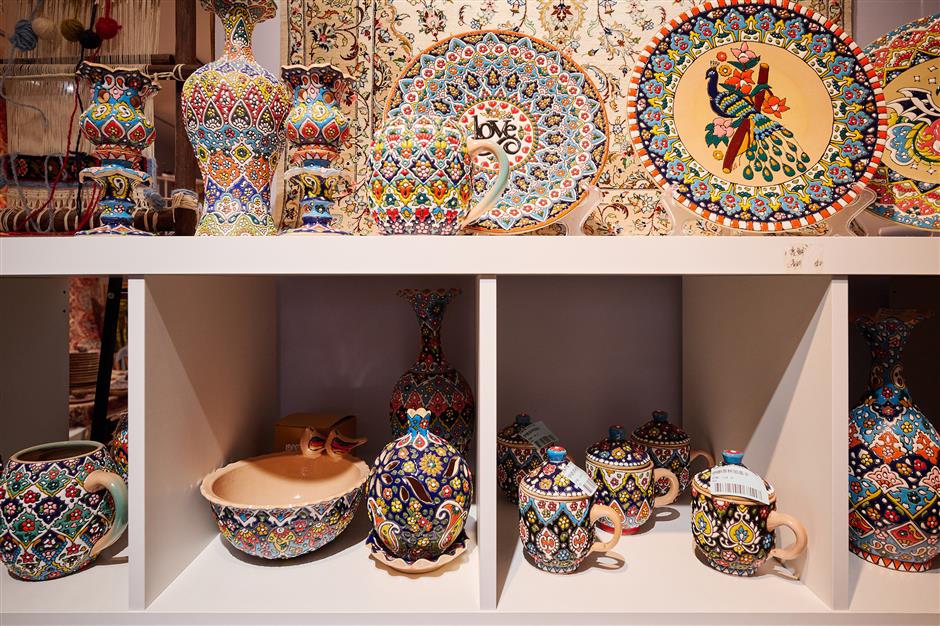
A shelf of dotted mugs, jars and teapots. A housewarming present for someone with a very white apartment.
Pakistan's section is the shiniest, and that is the onyx. The stone comes out of Balochistan, translucent and banded, and gets turned into vases, mortars and pestles, elephants, tea sets and cups that glow when the light hits them. The banding is never the same twice.
On the food side there are boxes of Jazaa cookies and cake rusk, bags of Sela basmati rice and National biryani spice mix. You can buy an onyx vase and dinner in the same transaction.
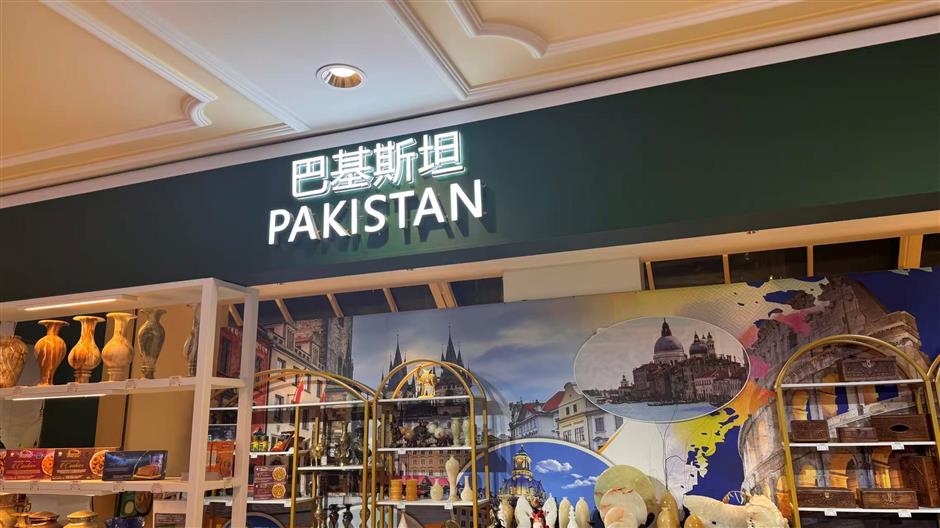
Pakistan, in glowing letters, and a lot of shelf space behind it.
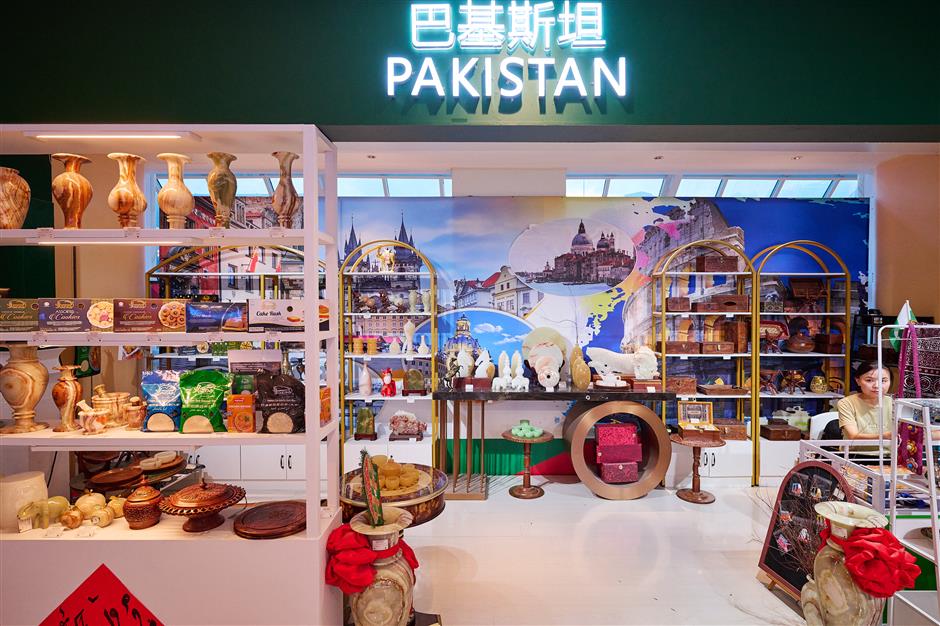
The whole corner. Rice, spice mix, cookies and stone, all under one painted skyline.
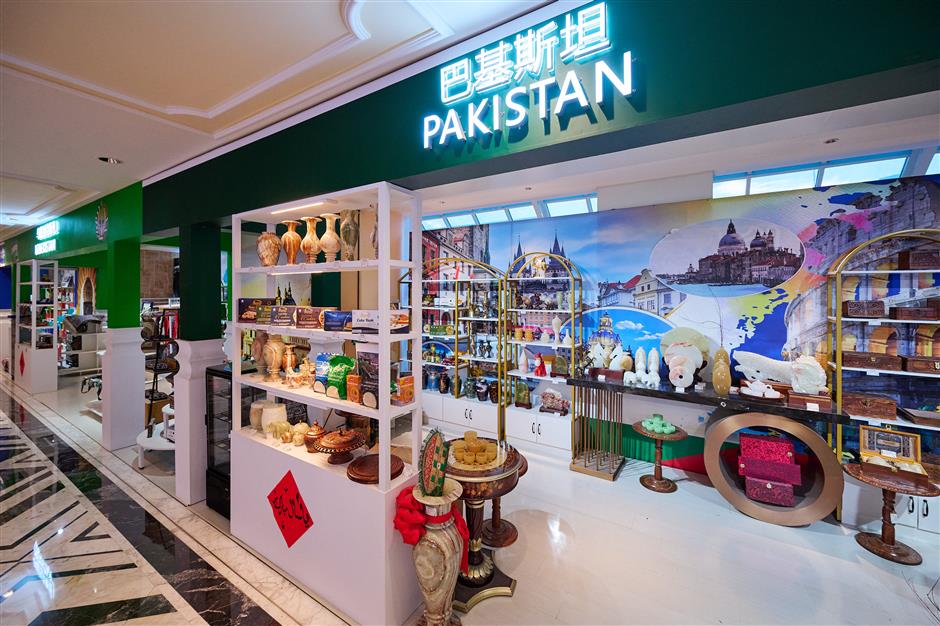
Another angle on Pakistan, because it's a big corner and I like it.
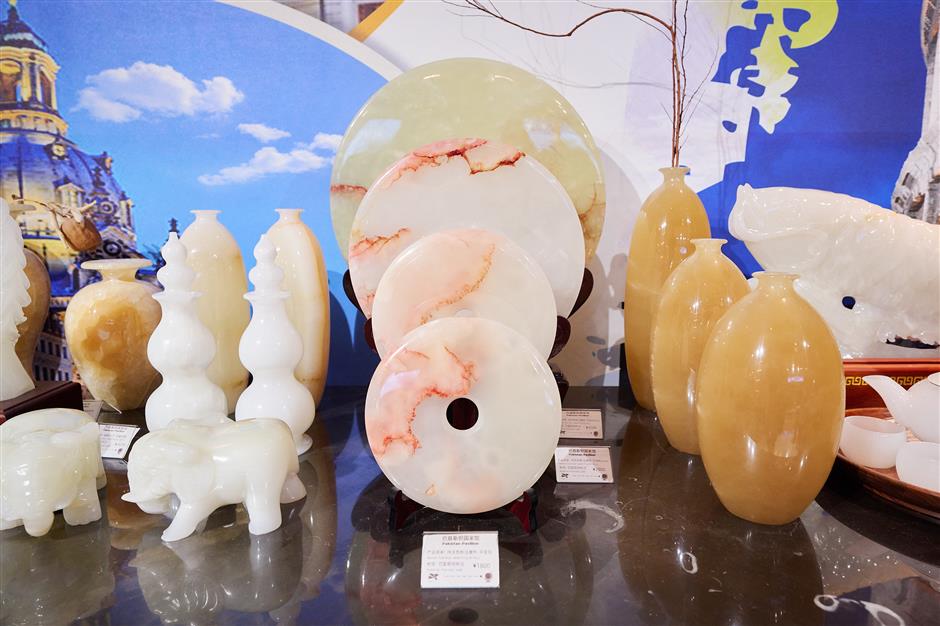
Onyx from Balochistan, banded and translucent, is turned into vases and elephants. The banding is never the same twice.
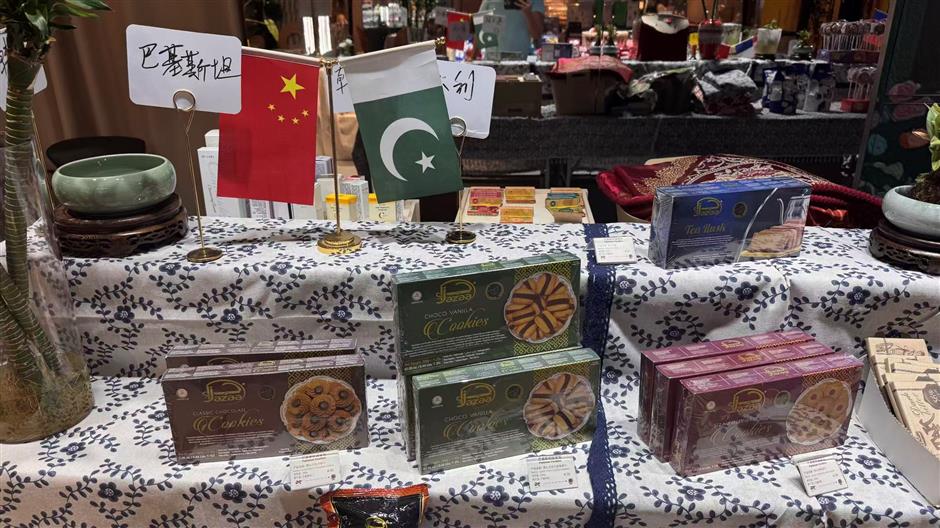
Jazaa cookies and cake rusk, with a China flag and a Pakistan flag. You can buy an onyx vase and dinner in the same transaction.
Australia gets a wood-paneled wine room with velvet armchairs and a life-size kangaroo statue keeping watch. Of every country in here, Australia is the one you can already find at a supermarket. It's mostly wine and spirits.
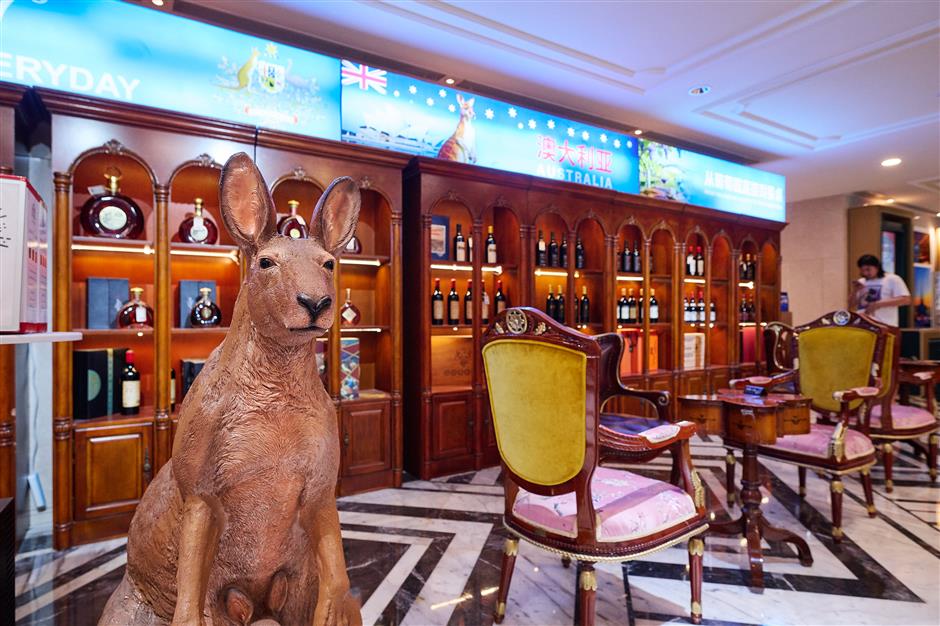
A life-size kangaroo guarding a wood-paneled wine room with velvet armchairs. The kangaroo is the reason to go in.
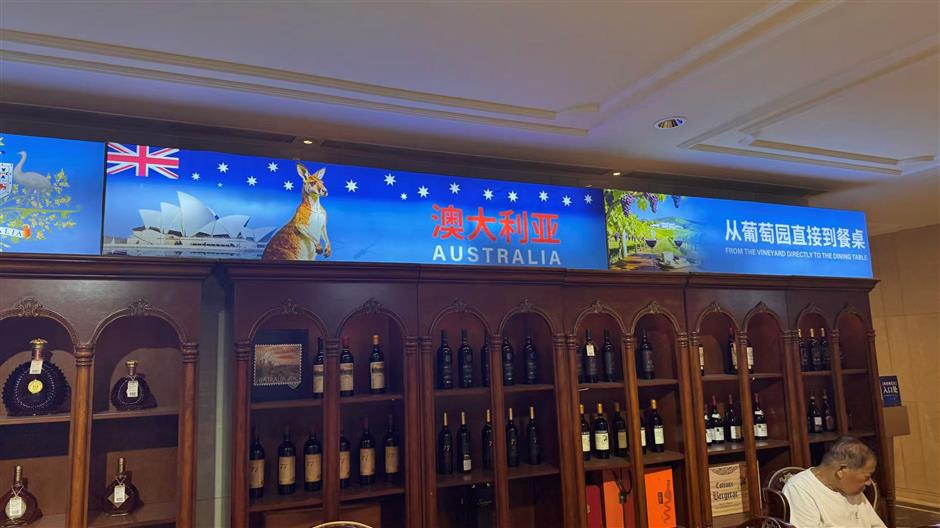
Australian wine, floor to ceiling. You can find most of this at a supermarket. You cannot find a kangaroo at a supermarket.
And then there is everything else. Czech glassware on a pink shelf. A German natural skincare line selling a face mist called "fairy water." A wall of amber dessert wines at 358 yuan and 398 yuan. There is a lot I have not listed, because 2,300 products is a lot of products.
So what actually sells? Sun says the best movers come in two layers. One is a good-value global pantry and health staples. The other is Silk Road heritage handicrafts that carry emotional value. Mongolian cashmere and Iranian Minai pottery and carpets are both big sellers, and New Zealand milk powder and honey, Argentine red shrimp, and wines from France, Chile and Georgia are popular too.
Gift budgets come up at the counter every day. The manager says the most popular gifts split between good-looking cultural trinkets and healthy, practical pantry items, and that 200rmb goes further than you would think: one or two bottles of wine from a good region with some chocolate and snacks, or a small Mongolian scarf, or a small Iranian handicraft. Spending less does not mean having no options. Skip the big, all-in-one gift and go for something small with some personality.
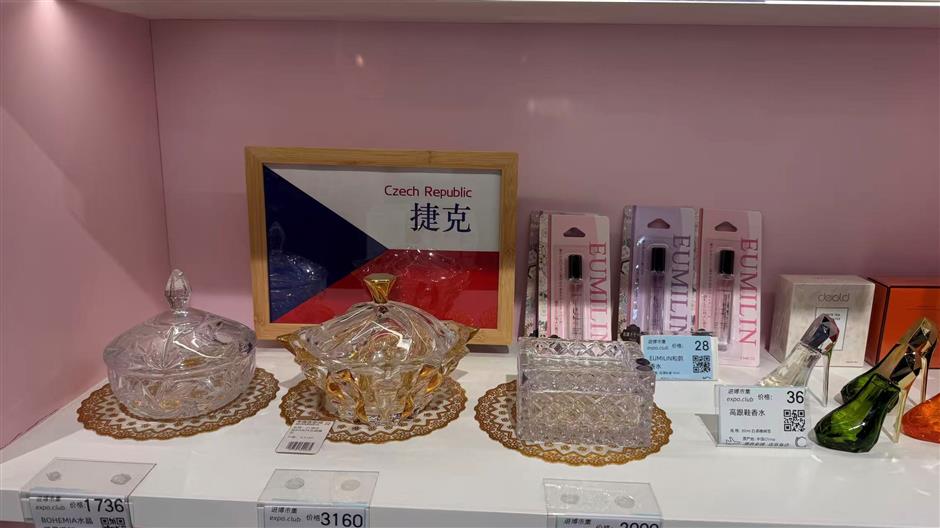
Czech glassware on a pink shelf. There's a lot I haven't listed. 2,300 products is a lot of products.
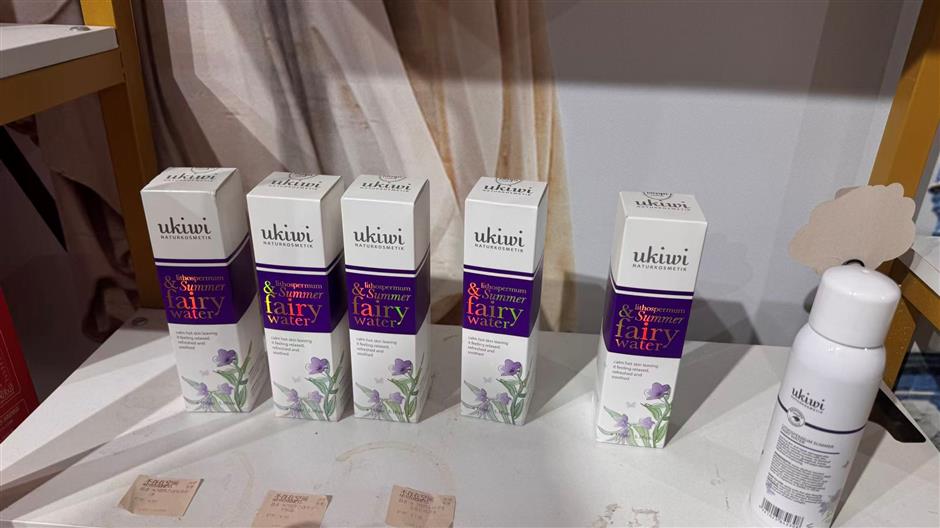
A German skincare line selling a face mist called "fairy water." I did not test it for magic.
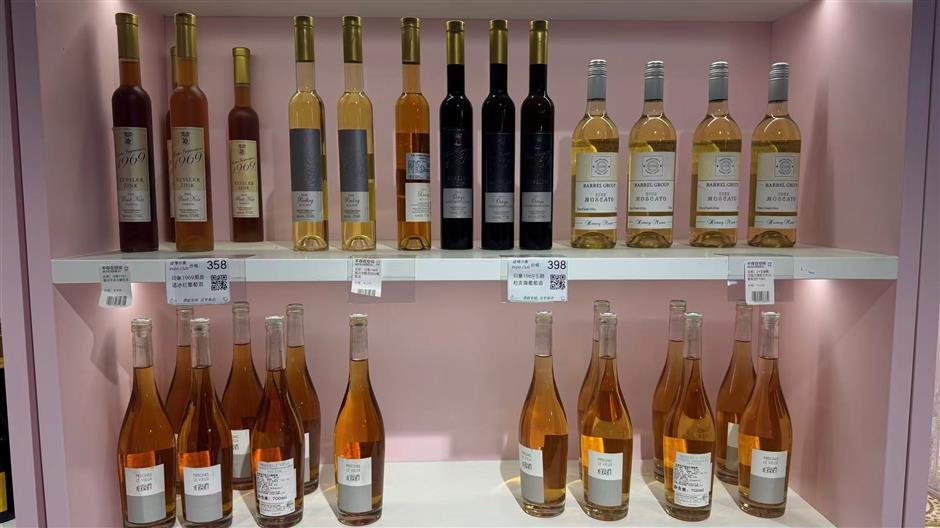
A wall of amber dessert wines at 358rmb and 398rmb. Do not drink all of them at once. (You can, though.)
A few things worth knowing. Nearly everything has a shelf tag with a price and a QR code, so you are not guessing. New stock arrives with each expo, which makes this week and next the best time to go. And if you are headed up to Global Harbor's 52nd-floor observation deck, the way up has run through this floor.
CIIE lasts six days. This lasts until they run out of Serbian biscuits.
If you go...
Opening hours: 10am to 10pm (Global Harbor mall hours)
Address: 5/F, Global Harbor, 3300 Zhongshan Rd N. 中山北路3300号5楼
Metro: Jinshajiang Road Station, Lines 3, 4 and 13


















 2026-11-08