Shot by Yu Wenhao. Edited by Yu Wenhao. Reported by Yang Jian. Subtitles by Yu Wenhao.

Ti Gong
Poster for ACS KIDS' halftime performance at the NBA game between the Chicago Bulls and the Toronto Raptors on February 19.
Twenty-five Shanghai teenagers transformed the home court of the National Basketball Association's Chicago Bulls into a sea of "China red" on February 19, marking a milestone for Chinese youth street dance on the global stage.
The crew, known as ACS KIDS, stood at center court in black before shedding their jackets to reveal crimson outfits.
The sudden shift, paired with the piercing notes of a traditional suona horn, brought Chinese folk elements to the heart of American basketball.
"When the music started and I saw the red on our bodies – and the Bulls logo beneath our feet – I felt a deep sense of pride," 16-year-old team captain Xue Enqi told Shanghai Daily.
The performance followed years of rigorous training. The group, also known as "Reinforced Concrete Youth," often rehearses past midnight. Most of the team members are teenagers, aged 6 to 17.
During major preparations, the lights in their Shanghai studio near Jing'an Temple often stay on until 3-4am.
"We can change the outcome until the very last second," said founder Hu Bowen. "Even a 1 percent improvement matters. Once the result is set, 'if only' means nothing."
Parents formed a WeChat group named after his mantra: "Shut Up and Move Forward."
"Everyone works hard," Hu noted. "Talking about effort means nothing."
Hu accepted the NBA's invitation after the team won a national championship and performed at last year's CCTV Spring Festival Gala, China's most-watched annual television broadcast. They performed alongside A-list stars, including singer Chris Lee and actor-singer Jackson Yee.
The group performed during the halftime show of the NBA clash between the Bulls and the Toronto Raptors, which the visitors won 110-101.
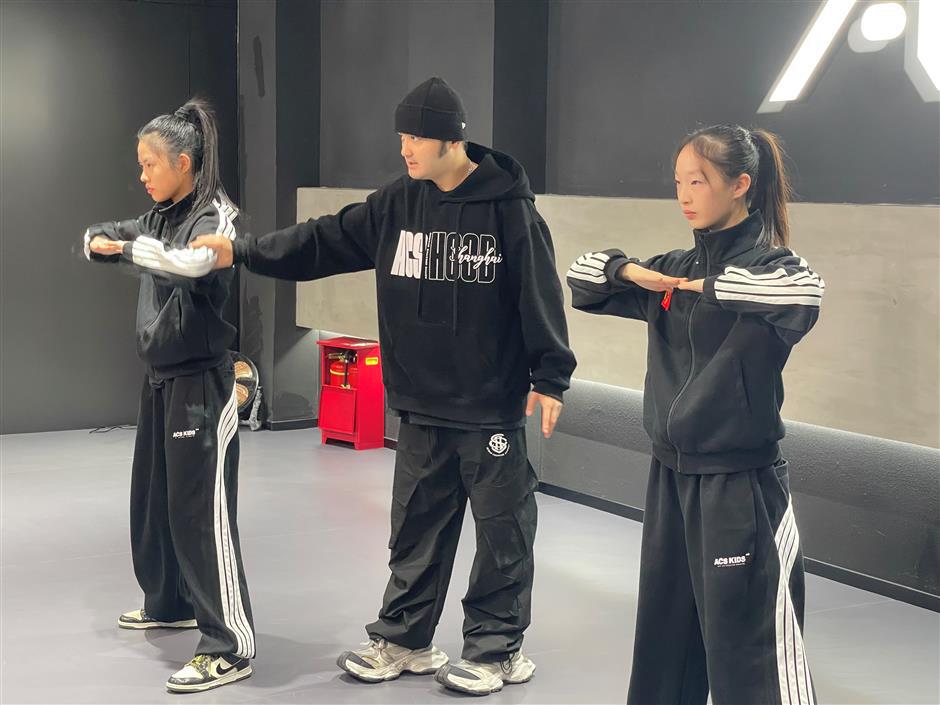
Yang Jian / Shanghai Daily
Hu Bowen (center), founder of ACS KIDS, guides team members Xue Enqi (left) and Xi Zilan at the dance studio near Jing'an Temple in Shanghai.
At center court in Chicago stood Xue, who studies at the Xuhui campus of the Fudan University Affiliated High School, one of Shanghai's most competitive academic institutions. Her goal is admission to Fudan University.
"I like science," she said. "Math and physics make sense to me."
But choreography remains her long-term ambition, following the path of her mentor Hu.
"Dance is part of my life. I will never give it up."
She hopes future university studies will strengthen her thinking and support her creative work.
"If you want to do both well, you have to sacrifice your entertainment time," Xue claimed. "You seize every fragment of time."
During intense preparation periods, she sometimes left rehearsals at 3am, completed homework until dawn, slept briefly and returned to training.
Xue's mother has driven her to rehearsals since primary school.
"She was 4 or 5 when we noticed she couldn't even walk steadily," her mother recalled. "But she liked to dance."
What began as a childhood movement became a long-term commitment. When rehearsals run late, her mother keeps her concerns to herself.
She said she has never seen her daughter cry from exhaustion. The tears come only at finish lines, whether in victory or defeat, when the weight of the journey catches up.
"The dance skills are actually the smallest part," the mother said. "Time management, efficiency, persistence – those help her more in life."
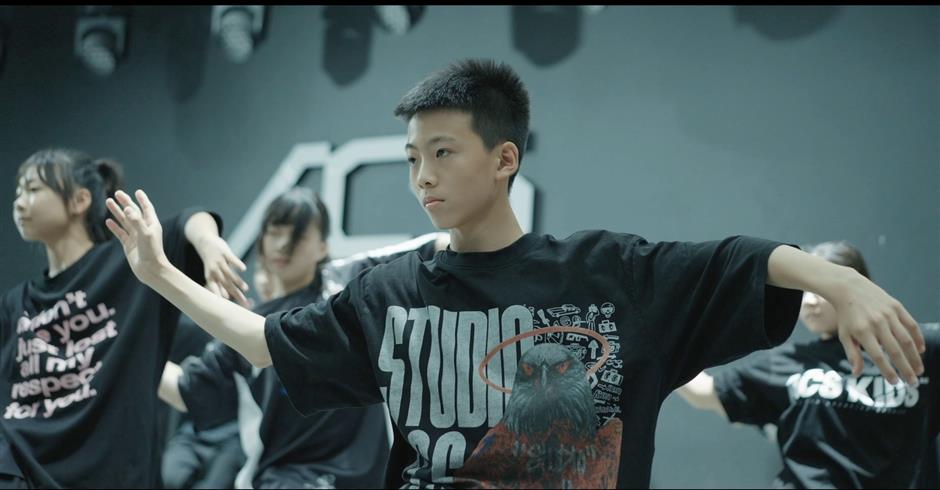
Ti Gong
ACS KIDS team members practice baguazhang (Eight Trigrams Palm) to bring traditional Chinese culture into their dance.
Street dance originated in the United States and spread globally through hip-hop culture. Hu acknowledges that history but resists imitation.
"Street dance is a foreign culture," he said. "If we want to move the world, I want to express it in a way that belongs to us."
He invited teachers of Wing Chun, baguazhang (Eight Trigrams Palm) and classical Chinese dance to train their bodies. Then he choreographed based on what they taught. He said martial arts footwork reshaped transitions. Traditional posture influenced arm control.
The suona became a recurring motif.
"That one second when it starts," Hu said, "is the moment that hits the audience's heart."
Sixteen-year-old dancer Xi Zilan felt that moment from inside the formation.
"When we took off the black costumes and revealed the red inside, I felt excited," she said of the halftime Chicago performance. "Red represents China. We wanted to show that to the world."
"Even the cameraman in front of us, who was filming, screamed and cheered at the moment."
The NBA performance circulated widely on social media. On YouTube, the video garnered over 18,000 views in its first 21 hours. Within the team, the response was restrained.
"We make a simple post to record it," Xi said. "Then we move on."
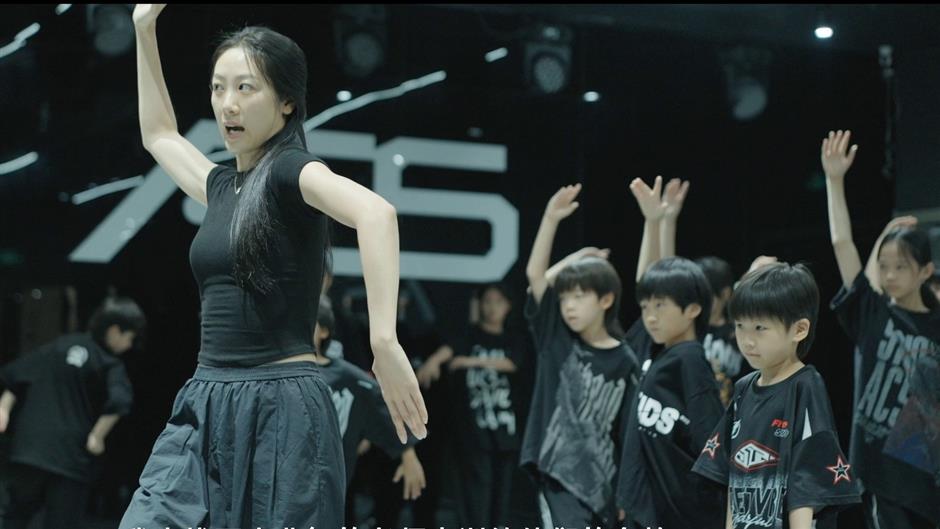
Ti Gong
A classical dance instructor trains the ACS KIDS team in body expression.
Hu began his career at the Shanghai Institute of Visual Arts, where he studied dance and developed his style. He gained attention during China's early short-video boom. His name spread quickly as street dance grew online. Expectations rose just as fast.
"There was a period when I wasn't training seriously enough," he said. "Fame came too early."
He later joined major competitions and television programs, including the franchise "Street Dance of China." The results did not match expectations.
"As a dancer, I may have missed my physical prime," he said. "That chapter has turned."
He now shifted his focus to building a younger team. He said the late rehearsals and the "1 percent" rule are not about trophies. They are about discipline. He wants his students to learn earlier what he learned later.
Courtside in Chicago, as the suona cue sounded and the arena turned red, Hu stood filming on his phone.
"Every time I watch them perform, my eyes are filled with tears."
He said it is not the applause that moves him, but the late-night corrections, the repeated rehearsals, and the years of accumulated experience of the young team.
"They may not all become professional dancers," Hu observed. "But I hope this spirit stays with them for life.
"When they face difficulties one day, they may remember these nights – and know that effort changes outcomes."



















 2026-03-06