There is a specific kind of confidence that French food carries into a room. Not arrogance, exactly, though it has been mistaken for that. More like the self-assurance of something that has been correct for a very long time and knows it. A properly made beurre blanc (a buttery white wine sauce that, done right, is basically liquid silk). A soufflé that rises on schedule. A cassoulet (a slow-cooked southern French stew of white beans, sausage and duck) that has been going since yesterday. These are not dishes that ask for your nod. They expect it.
Shanghai has been on complicated terms with French cuisine for long. The tree-lined streets of Xuhui and Jing’an districts were not designed with the food in mind, but the association stuck anyway. Platane trees lining Wukang Road, cream-colored lane houses, cafés with chairs facing outward toward the street: The visual grammar is Gallic even if the scallion oil noodles from the nearby wet market tell a different story. The French were here, and they left an imprint. And the city has been negotiating with that imprint ever since.
Architecture of French cooking
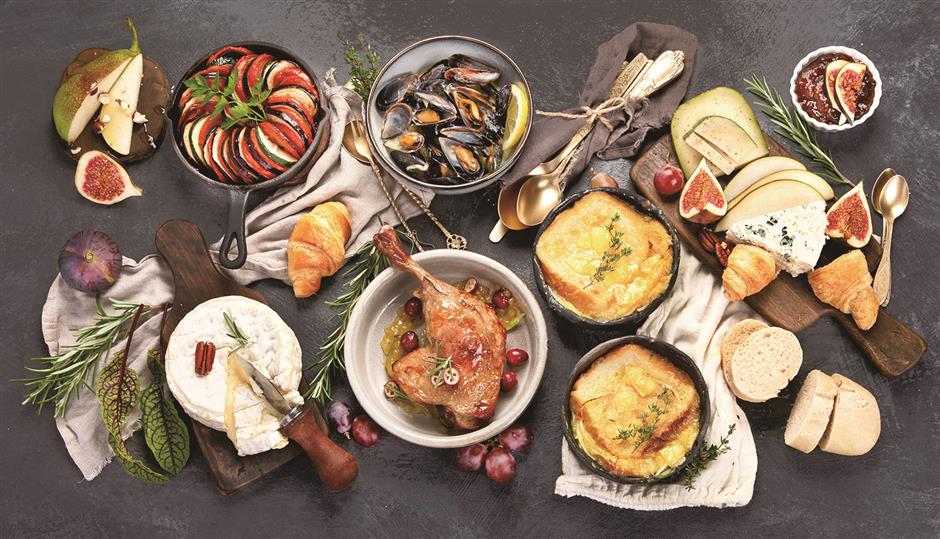
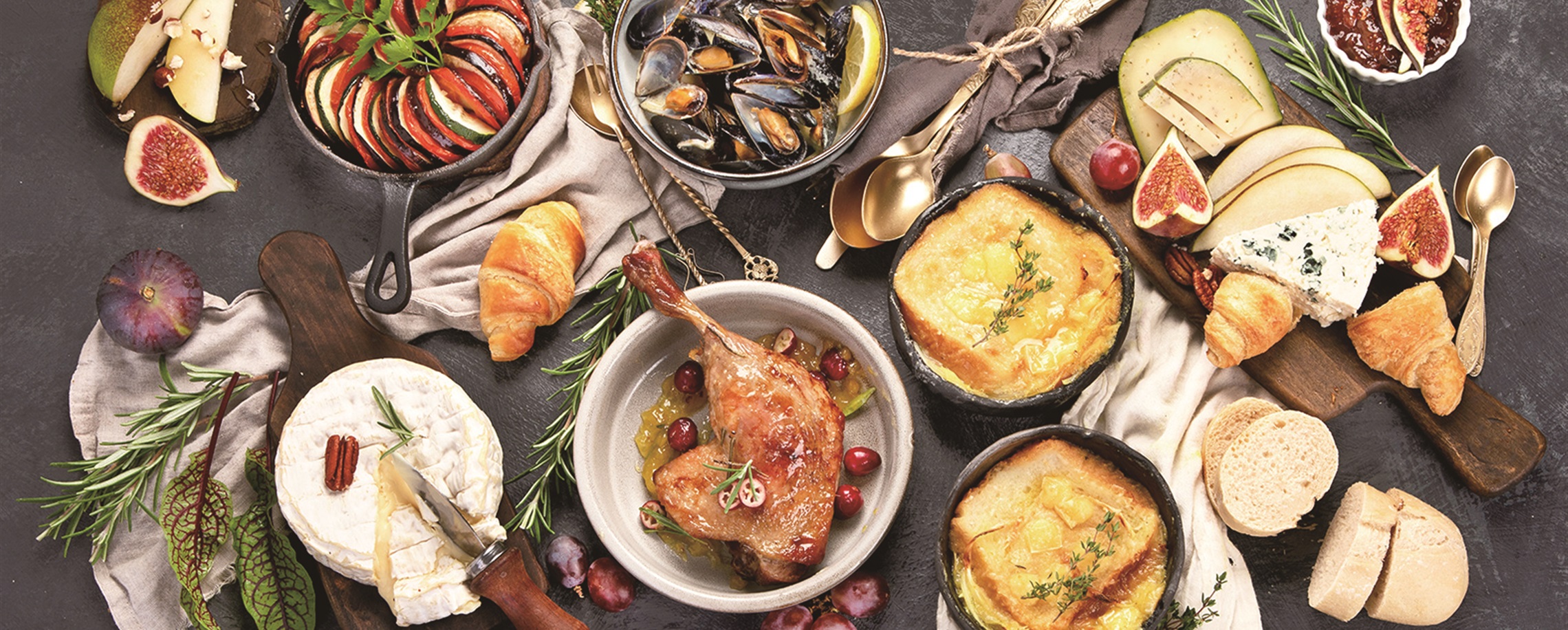
French cuisine is, at its core, a cuisine of transformation. The raw ingredients matter, but what happens to them matters more. A stock reduced for six hours until it coats a spoon. A duck leg confited (slow-cooked submerged in its own fat) until the meat gives up entirely and becomes something new. A sauce built from the fond (the browned bits left after searing), deglazed (lifted into liquid) with cognac, finished with cream: three minutes of work that could not happen without the 20 minutes of searing that preceded it. The technique is the point. The technique is the dish.
This is not how most of the world cooks. Chinese cooking operates on different principles: freshness, the wok, the flash of high heat and the ingredient at its peak. Southeast Asian cooking chases a live negotiation between opposing flavors. French cooking is slower, more interested in building depth than in declaring brightness. A French mother sauce (the five foundational sauces: béchamel, velouté, espagnole, hollandaise and sauce tomat) is a foundation, not a finish. The rest proceeds from there.
The regional variations are considerable. Brittany and Provence are not the same country, gastronomically speaking. Brittany gives you butter in quantities that feel almost punitive, buckwheat galettes (savory crepes), oysters cold from the Atlantic, cider instead of wine. Provence gives you olive oil, tomatoes and the anise funk of pastis (an anise-flavored aperitif). Alsace, bordered by Germany and shaped by two centuries of political back-and-forth, gives you choucroute garnie (braised sauerkraut loaded with sausages and cured pork) and flammekueche (a thin-crusted Alsatian tart with crème fraîche, onions and lardons) and a riesling tradition that the region guards with appropriate ferocity. Lyon, which has the reasonable claim to being the actual gastronomic capital of France, gives you bouchons (small traditional Lyonnaise bistros) serving quenelles de brochet (poached pike dumplings in cream sauce), tablier de sapeur (breaded and fried tripe), cervelle de canut (a herbed fresh cheese), and enough pork offal to last a lifetime. These cuisines share a language. They do not share a dialect.
Bread, butter and the rest
If there is a spine to French food, it is bread. The baguette (the long thin form was standardized in the 20th century) has become so embedded in French daily life that a 2022 UNESCO inscription formalized what everyone already knew: This is cultural heritage. The pain de campagne (rustic French country bread) with its thick crust and open crumb, the brioche that blurs the line between bread and cake: All of it proceeds from the same insistence that bread is not an industrial product.
Butter follows. French butter, particularly from Normandy and Brittany, is churned at higher fat content than most of the world’s butter and aged to a cultured, slightly tangy depth. It is the reason a croissant made with French butter tastes different from one made with anything else. The bread arrives before anything else. The butter arrives with it.
Then: the cheese. France produces over 1,000 distinct varieties. The ones that survive the journey to Shanghai’s better fromageries (specialist cheese shops) and restaurant cheese carts (a Comté aged 18 months, a proper Époisses, a Roquefort with its blue veins intact) are a reminder that dairy, properly handled, is capable of extraordinary things.
A community and its tables
Shanghai’s French community is among the largest in Asia, concentrated predictably in the Wukang Road and Jing’an neighborhoods, organized around the Lycée Français de Shanghai, the Alliance Française, and a social circuit of expat communities.
What this community has produced, over the past two decades, is a French restaurant scene that is more serious than the city usually gets credit for. The hotel restaurants exist, with their imported consultants and their tasting menus priced for expense accounts. But alongside them: a layer of smaller, chef-driven places that are doing something more interesting. Bistros where the plat du jour (the day’s set dish) is written on a chalkboard and changes when it runs out. Wine bars with by-the-glass programs that treat natural wine not as a trend but as a preference. Patisseries where the croissants come out at a specific hour and are gone by a specific other hour.
The chefs running these places tend to fall into one of two categories. The first: French nationals who came to Shanghai for a posting, stayed because the city got under their skin, and are now doing their most personally expressive cooking here. The second: chefs who trained in France, came back with technique and a perspective, and are now cooking food that is French in method and locally inflected in ingredient. The most interesting version of this story. No single figure defined what French fine dining could mean in Shanghai more than Paul Pairet. His Ultraviolet, was Shanghai’s first restaurant to receive three Michelin stars until it closed in 2025. The good news is that Pairet’s more democratic instincts live on: Mr & Mrs Bund on the Bund remains one of the city’s most reliably pleasurable French rooms, and Polux in Xintiandi does the all-day bistro format with unfussy competence.
The crossover category keeps producing work worth seeking out. Canfa on Taian Road takes a Cantonese-French approach; La Scène Ronde runs an omakase-format tasting menu that is French in architecture and Japanese in sensibility. These are not novelties. They are what happens when a cuisine travels far enough and long enough to genuinely take root.


















 2026-07-08