The world's longest undersea high-speed rail tunnel is now drilling in both directions beneath the sea.
That means high-speed trains between Shanghai and Zhoushan will be on track soon.
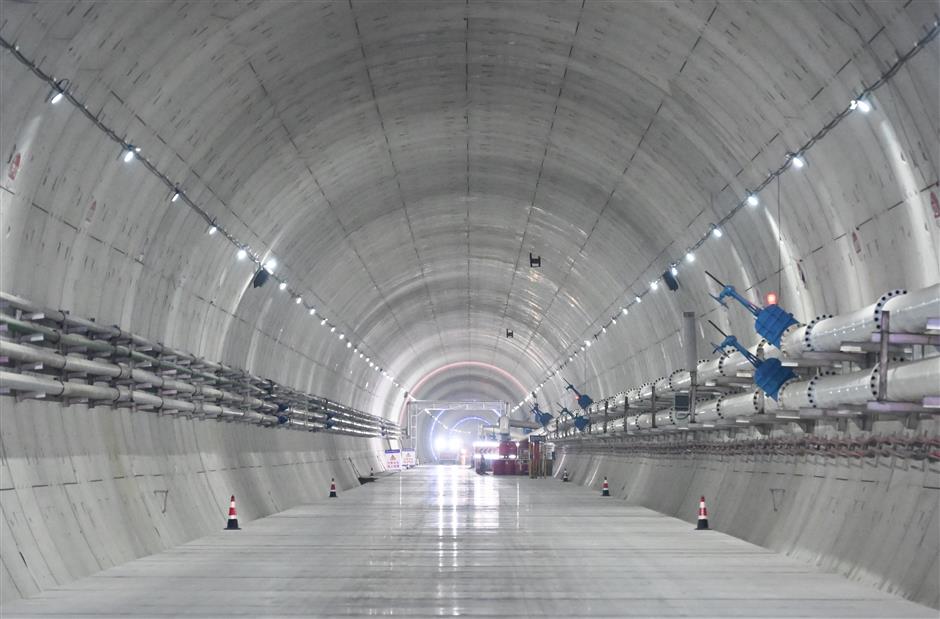
Imaginechina
Part of the Jintang Undersea Tunnel takes shape.
A World-Record Undersea Tunnel
Last Thursday, a major milestone was reached in the construction of the Ningbo-Zhoushan Railway – the ambitious infrastructure project connecting two key cities in the Yangtze River Delta region, near Shanghai.
The "Yongzhou (Ningbo-Zhoushan)" tunnel-boring machine (TBM) broke through the sea wall from 64 meters underground on the Ningbo side, officially entering the ocean section of the Jintang Undersea Tunnel.
Stretching 16.18 kilometers in total, the tunnel will be the longest undersea high-speed rail tunnel in the world, running beneath the Jintang Channel between Beilun District in Ningbo and Jintang Town in Zhoushan.
A New Era for Zhoushan: From Island to Mainland in Minutes
The Ningbo-Zhoushan Railway is a key national project under China's Mid-to-Long Term Railway Network Plan (2016-30). The route includes:
Seven Stations: Ningbo East, Yunlong, Qiu'ai, Beilun West, Jintang, Ma'ao and Zhoushan.
New tunnels and bridges connecting the islands of Jintang, Cezi and Zhoushan.
Upon completion, Zhoushan – long inaccessible by train – will be officially connected to the national railway network.
Shanghai to Zhoushan: Only 40 Minutes
The best news? Travel time between Shanghai and Zhoushan could shrink from 2 hours by car to just 40 minutes by high-speed rail.
The new Ma'ao Station has already been designed to accommodate a future connection with the Shanghai-bound rail line, forming part of the larger Shanghai-Ningbo-Zhoushan cross-sea corridor.
Dual TBM Operation: East Meets West Underwater
Two massive TBMs – "Dinghai" from Zhoushan and "Yongzhou" from Ningbo – are tunneling toward each other beneath the seabed, facing extreme water pressure and complex geology.
"Dinghai" began in October from the east; now "Yongzhou" is advancing from the west. Though its route is shorter (4,940 meters vs 6,270), the Ningbo side is far more challenging, crossing 24 alternating layers of soft and hard rocks.
This project also marks a first in China's high-speed rail tunneling: the use of a remote-controlled system.
Like autonomous driving, the TBM is monitored from the surface and can issue automatic alerts if conditions exceed preset safety limits.
Boosting Regional Growth
This high-speed link will:
- Strengthen neighboring Zhejiang Province's 1-hour transport circle;
- Enhance tourism, commerce and regional integration in the Yangtze River Delta region;
- Enable direct train services from Zhoushan to Shanghai, Nanjing, Beijing, Tianjin, Wuhan, Xi'an, Kunming, Guangzhou, Shenzhen, and more.


















 2026-03-06