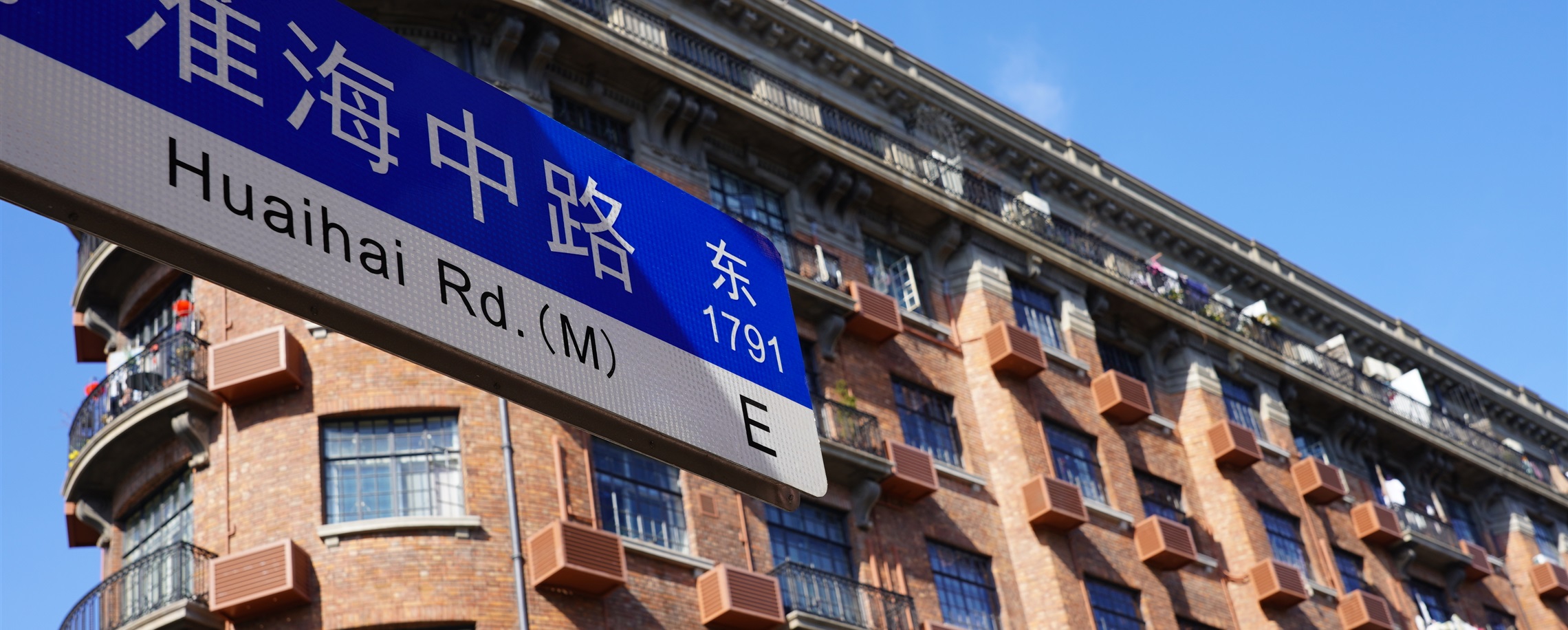
Hai Streets is our semi-regular column on Shanghai's great commercial arteries. From Nanjing Road East's blend of heritage storefronts and pop-culture malls to Huaihai Road's luxe lanes and Hongqiao area's international cultural diversity hubs, we explore how Shanghai's commercial hubs drive billions in sales and shape the city's identity – where commerce, culture and history collide in neon, nostalgia and non-stop foot traffic.
![[Hai Streets] Walking through time: Huaihai Road's quiet architects of history](https://obj.shine.cn/files/2026/01/01/e539e1e4-6744-4aac-ab92-bc703b59f540_0.jpeg)
Imaginechina
Behind the plane trees and storefronts of Huaihai Road Middle lies Shanghai's modern history of revolutionary leaders, writers, artists, scientists, diplomats, and industrial tycoons.
This tour takes you through some of Shanghai's most famous homes, revealing the hidden lives behind Huaihai Road's elegant facades before ending at J.G.Ballard's childhood home on Panyu Road.
Start Point: Former Mansion of Sun Yat-sen in Shanghai 孙中山行馆旧址
Begin at the quiet lane just north of the main road. In December 1911, shortly after the Xinhai Revolution, Sun Yat-sen stayed in this elegant three-story garden residence. The house exemplifies the early 20th-century verandah-style villa, characterized by deep arcades and a serene courtyard atmosphere, illustrating the emergence of modern garden residences in Shanghai.
Address: No. 3, Lane 650, Huaihai Rd M. 淮海中路650弄3号
![[Hai Streets] Walking through time: Huaihai Road's quiet architects of history](https://obj.shine.cn/files/2026/01/13/bb45d3ff-e2fa-4170-abe2-3de804d04531_0.jpg)
Ti Gong
Historical photograph of the former mansion of Sun Yat-sen in Shanghai
![[Hai Streets] Walking through time: Huaihai Road's quiet architects of history](https://obj.shine.cn/files/2026/01/13/752bf8e6-8b23-4704-ab7e-3c4d52d7c496_0.jpg)
Ti Gong
Former mansion of Sun Yat-sen in Shanghai
Stop 1: Huaihai Lane 淮海坊 (Formerly Joffre Lane 霞飞坊)
Enter Huaihai Lane, one of the most culturally important "lilong" communities in the city. Built in the mid-1920s by a Belgian Catholic charity, it was originally named Joffre Lane when Huaihai Road was known as Avenue Joffre.
Its houses were French-inspired with steel windows, cast-iron entrance gates, narrower courtyards, and a row-style plan. Long blocks of 30 residential units were rare in Shanghai's lilong housing. Wide alleys, uniform double-pitched roofs, rows of small chimneys, and clean, red-brick façades create a monumental architectural rhythm that persists to this day.
Address: Lane 927, Huaihai Rd M. 淮海中路927弄
![[Hai Streets] Walking through time: Huaihai Road's quiet architects of history](https://obj.shine.cn/files/2026/01/12/c3f4144c-35b2-4230-a908-f8ea3756e016_0.png)
Ti Gong
Entrance of Joffre Lane at Route Cardinal Mercier (now Maoming Road S.), 1930s
![[Hai Streets] Walking through time: Huaihai Road's quiet architects of history](https://obj.shine.cn/files/2026/01/12/11aaf900-628f-4846-afa2-bb7fa7bb4c57_0.png)
Ti Gong
Huaihai Lane after Renovation
![[Hai Streets] Walking through time: Huaihai Road's quiet architects of history](https://obj.shine.cn/files/2026/01/04/427d37a0-2606-4a41-a2b8-6e5abd3f01b6_0.jpg)
Imaginechina
Stop 2: Former Residence of Ba Jin 巴金故居
Huaihai Lane was home to Ba Jin, one of China's greatest modern novelists. He moved into this apartment in July 1937, entering one of the most productive periods of his literary career. The novel Spring, which he conceived in an attic room of his previous residence, was completed here, and in 1939, he finished Autumn. In the preface to Autumn, he recalled writing every night from 9 pm until 2 or 3 am, living in near seclusion.
Family memories describe the apartment as "crowded with books:" a narrow bedroom with a desk by the window, an iron bed against the wall, glass-fronted bookcases filling nearly every corner, and twisting paths left between piles of volumes. After the war, Ba Jin returned to this apartment in 1946 and later wrote Cold Nights before moving away in 1955.
Address: Huaihai Lane No.59 淮海坊59号
![[Hai Streets] Walking through time: Huaihai Road's quiet architects of history](https://obj.shine.cn/files/2026/01/12/db774782-f05a-4285-9664-49c41cc7cc14_0.jpg)
Ti Gong
Former residence of Ba Jin
![[Hai Streets] Walking through time: Huaihai Road's quiet architects of history](https://obj.shine.cn/files/2026/01/12/1a90d551-1910-451a-8020-7521cf8bd9ac_0.jpg)
Ti Gong
Ba Jin with his wife and daughter Li Xiaolin at their residence, No.59 Huaihai Lane, winter 1949.
Stop 3: Former Residence of Xu Guangping 许广平旧居
After Lu Xun, the towering figure of modern Chinese literature, passed away in October 1936, his widow, Xu Guangping, moved to this location with her son at the end of that year. They occupied the second floor, while the third floor was converted into a space for storing Lu Xun's books and relics. His manuscripts were hidden even more carefully – buried in a coal pile in the kitchen corner to evade sudden searches.
In April 1938, Xu Guangping and Hu Yuzhi made the decision to publish The Complete Works of Lu Xun. A five-member editorial team was assembled, and Xu collaborated with Wang Renshu in a small attic room, checking every manuscript word by word. Through pre-orders and donations, they successfully published the six-million-character collection in just four months, marking one of the most remarkable achievements in modern Chinese publishing history.
Address: Huaihai Lane No.64 淮海坊64号
![[Hai Streets] Walking through time: Huaihai Road's quiet architects of history](https://obj.shine.cn/files/2026/01/12/cf766402-0031-4f9d-bfdf-ac2fab861b30_0.jpg)
Ti Gong
Xu Guangping with her son Zhou Haiying in Huaihai Lane, July 1946.
Stop 4: Former Residence of Zhu Kezhen 竺可桢旧居
Geographer and meteorologist Zhu Kezhen lived here. His presence shows that Huaihai Lane was not only a writers' enclave but also a cradle of modern Chinese science. Zhu pioneered Chinese climatology and phenology. A Harvard PhD, former president of Zhejiang University, and later vice-president of the Chinese Academy of Sciences, he laid the foundations for China's modern earth sciences.
Address: Huaihai Lane No.26 淮海坊26号
![[Hai Streets] Walking through time: Huaihai Road's quiet architects of history](https://obj.shine.cn/files/2026/01/13/396b530c-c3a7-4edb-8ae0-74c735493440_0.jpg)
Ti Gong
Stop 5: Former Residence of Hu Die 胡蝶旧居
Born in Shanghai in 1908, Hu Die was celebrated as "China's Greta Garbo." From her early training at the Shanghai China Film School to starring in classics such as Songstress Red Peony, China's first sound film, she became the face of Chinese cinema in the 1930s.
Her residence here connects Huaihai Lane not only with literature and painting but also with the golden age of Chinese film.
Address: Huaihai Lane No.33 淮海坊33号
![[Hai Streets] Walking through time: Huaihai Road's quiet architects of history](https://obj.shine.cn/files/2026/01/12/4eca57e5-95f2-400d-98fa-958a839a8799_0.jpg)
Imaginechina
Hu Die, the "queen of Chinese cinema"
Stop 6: Former Residence of Xu Beihong 徐悲鸿旧居
Painter Xu Beihong and his wife, Jiang Biwei, moved to this address in October 1927 and lived there for more than a year. During their time there, Xu, along with Tian Han and Ouyang Yuqian, co-founded the Southern Society (南国社) to unite progressive youth and initiate an "artistic revolution."
The Southern Revival Conference, held at Xu's home, attracted over 40 attendees. This society played a significant role in advancing modern Chinese drama, music, film, and publishing.
Address: Huaihai Lane No.99 淮海坊99号
![[Hai Streets] Walking through time: Huaihai Road's quiet architects of history](https://obj.shine.cn/files/2026/01/13/6004522a-4367-4f2b-b748-a6061eff9bb2_0.png)
黄浦文博
Xu Beihong and his family at No.99 Huaihai Lane
![[Hai Streets] Walking through time: Huaihai Road's quiet architects of history](https://obj.shine.cn/files/2026/01/13/919bf7b4-f485-4256-939f-5ae74e869de2_0.png)
Ti Gong
Stop 7: Former Residence of Nie Er 聂耳旧居
Nie Er, composer of the national anthem March of the Volunteers, lived in this 1933 three-story Shanghai apartment. The brick-and-concrete building has decorative gables and carved reliefs under the eaves. It is now a residential property but is still listed as a Shanghai Revolutionary Heritage Site, marking the place where the anthem's creation took shape.
At Nie Er Music Square, 1434 Huaihai Road M., a statue honors the composer.
Address: 3F, 1258 Huaihai Rd M. 淮海中路1258号3楼
![[Hai Streets] Walking through time: Huaihai Road's quiet architects of history](https://obj.shine.cn/files/2026/01/13/bfbe262d-fc1c-4171-9be6-23a3535c470a_0.jpg)
Ti Gong
Former residence of Nie Er
![[Hai Streets] Walking through time: Huaihai Road's quiet architects of history](https://obj.shine.cn/files/2026/01/13/77cfb1e8-5677-4fd4-a204-cac38c0d0c5c_0.jpg)
Ti Gong
Stop 8: Villa Basset 巴塞住宅旧址
Villa Basset was built by a Frenchman in 1921. French business Crédit Foncier Compagnie designed the brick-concrete, three-story Spanish-style garden villa. A magnificent arched doorway with Ionic-style pilasters, a second-floor terrace with vase balustrades, colorful glazed-brick decoration beneath the eaves, and red Spanish roof tiles top the symmetrical south façade. A large lawn and mature trees remain on the south side.
The house was the Spanish Consulate General in Shanghai from 1934 to 1937, adding to its cosmopolitan heritage.
Address: 1431 Huaihai Rd M. 淮海中路1431号
![[Hai Streets] Walking through time: Huaihai Road's quiet architects of history](https://obj.shine.cn/files/2026/01/13/74bde300-2078-4567-aa89-cbae1bd68121_0.png)
Ti Gong
Historical photograph of Villa Basset
![[Hai Streets] Walking through time: Huaihai Road's quiet architects of history](https://obj.shine.cn/files/2026/01/13/65537d06-2580-4ff7-a7cb-ca491a47a555_0.jpg)
Ti Gong
Stop 9: Former Residence of Zhang Leping 张乐平故居
This English-style garden villa was the residence of Zhang Leping, the cartoonist famously known as the "Father of Sanmao." He lived here from 1950 until 1992, during which time he created numerous works, including "Sanmao the Orphan" and "Sanmao Joins the Army." The restored interior showcases his studio, bedroom, and original furnishings, allowing visitors to gain insight into the everyday life of the man behind China's most famous comic character.
Address: No. 3, Lane 288, Wuyuan Rd 五原路288弄3号
![[Hai Streets] Walking through time: Huaihai Road's quiet architects of history](https://obj.shine.cn/files/2026/01/13/5e6b3942-a610-4310-b6ef-85c653525aaa_0.png)
Ti Gong
Former residence of Zhang Leping
![[Hai Streets] Walking through time: Huaihai Road's quiet architects of history](https://obj.shine.cn/files/2026/01/13/da8211cc-5482-47c4-bb9e-cd5539aeb5f9_0.png)
Ti Gong
The exhibition hall is on the first floor.
![[Hai Streets] Walking through time: Huaihai Road's quiet architects of history](https://obj.shine.cn/files/2026/01/13/8e812a3a-dcf0-4f70-b8f5-04f0dd5bd85f_0.png)
Ti Gong
The second-floor exhibition hall
Stop 10: Former Residence of Sheng Xuanhuai 盛宣怀故居
This magnificent neoclassical mansion was home to Sheng Xuanhuai, the Qing Dynasty's industrial tycoon who created many of China's "firsts" in industry, education, and philanthropy. Built in 1900, it originally stood amid vast gardens, traces of which survive in the marble fountain and rockery.
Address: 1517 Huaihai Rd M. 淮海中路1517号
![[Hai Streets] Walking through time: Huaihai Road's quiet architects of history](https://obj.shine.cn/files/2026/01/13/4d79d8e8-f23a-4374-8df1-ba916ce0002f_0.jpg)
Ti Gong
Historical photograph of the former residence of Sheng Xuanhuai
![[Hai Streets] Walking through time: Huaihai Road's quiet architects of history](https://obj.shine.cn/files/2026/01/13/4ce171e4-322d-4dc2-88a0-9828acc6db5b_0.jpg)
Ti Gong
Former residence of Sheng Xuanhuai
Stop 11: Former Residence of Zhou Xuan 周璇旧居
From 1943 to 1946, the legendary singer and actress Zhou Xuan, known as the "Golden Voice of Shanghai," lived in this corner garden house. The years marked her triumphant return to the screen, starring in classics such as Street Angel, Dream of the Red Chamber, and Phoenixes in Love. Her songs – Wandering Songstress, Four Seasons Song, and later Night Shanghai – still echo the romance of old Shanghai. Behind the glamour, her tragic life story lends this quiet residence a deeply moving atmosphere.
Address: No.1, Lane 391, Wukang Rd 武康路391弄1号
![[Hai Streets] Walking through time: Huaihai Road's quiet architects of history](https://obj.shine.cn/files/2026/01/13/2bef2a51-4464-4082-a368-be23338b61ea_0.jpg)
Ti Gong
Former residence of Zhou Xuan
![[Hai Streets] Walking through time: Huaihai Road's quiet architects of history](https://obj.shine.cn/files/2026/01/13/c3480a72-a41c-4445-b7f6-9af015a21942_0.jpg)
Imaginechina
Stop 12: Former Residence of Chiang Ching-kuo 蒋经国旧居
In July 1948, Chiang Ching-kuo, then the deputy commissioner of Shanghai's economic control administration, moved his family to a Spanish-style garden villa across from what is now the Shanghai Library. The Yicun complex, completed in 1942, comprised eight identical three-story villas, each featuring its own small garden. Chiang later rose to prominence as the leader of Taiwan, and his short stay in this villa serves as a connection between the serene elegance of Huaihai's residential areas and the significant political shifts in modern Chinese history.
Chiang was a proponent of the "One China" principle, advocated for national reunification, and sought to improve cross-strait relations, expressing a desire to provide an honest account of history.
Address: No.2, Yicun, Lane 1610, Huaihai Rd M. 淮海中路1610弄逸邨2号
Stop 13: Soong Ching-ling Memorial Residence 宋庆龄故居
Built in 1920, this red-tiled French rural-style garden villa was one of the most important Shanghai homes of Soong Ching-ling, Honorary President of the People's Republic of China. From the spring of 1949 to 1963, she lived and worked here and continued to stay in the house whenever she returned to Shanghai after moving to Beijing.
The property covers about 4,330 square meters and is arranged around front and rear gardens shaded by century-old camphor trees. The interior is preserved as it was during her lifetime. Many Chinese leaders, including Mao Zedong, Zhou Enlai, Liu Shaoqi, Zhu De and Chen Yi, were received here, and several important essays were written at this house. Today, it serves as a major patriotic education site and a national-level protected monument.
Address: 1843 Huaihai Rd M. 淮海中路1843号
![[Hai Streets] Walking through time: Huaihai Road's quiet architects of history](https://obj.shine.cn/files/2026/01/13/566b3c16-79e7-4aaa-ba67-4ffff28ebcf6_0.jpg)
Virtual Shanghai
Residence of Soong Ching-ling (1990)
![[Hai Streets] Walking through time: Huaihai Road's quiet architects of history](https://obj.shine.cn/files/2026/01/13/a87bdc20-cee8-443e-97f4-7d3eacf8615e_0.jpg)
Imaginechina
Soong Ching-ling Memorial Residence
Stop 14: Former Residence of Du Zhongyuan 杜重远旧居
This garden residence was designed by László Hudec. It was home to Du Zhongyuan, an entrepreneur and patriotic intellectual who ran the influential anti-Japanese magazine New Life. The building's Renaissance-Mediterranean details make it one of the architectural gems of Huaihai Road.
Address: 1897 Huaihai Rd M. 淮海中路1897号
![[Hai Streets] Walking through time: Huaihai Road's quiet architects of history](https://obj.shine.cn/files/2026/01/13/8ba8256a-b7bd-490a-8463-d2fc2d52821c_0.jpg)
上海市历史建筑保护事务中心
Former residence of Du Chongyuan
End Point: Former Residence of J.G.Ballard
This historic Shanghai-style villa on Panyu Road is widely recognized as the former residence of J.G. Ballard, one of the most significant science fiction writers born in China. His experiences growing up in wartime Shanghai profoundly influenced his literary vision, particularly his idea of "inner space," where psychological reality intersects with the external world.
The villa continues to draw international readers who trace Ballard's footsteps through the city. Today, it serves as a reminder of how Shanghai once shaped a global literary imagination.
Address: 508 Panyu Rd 番禺路508号
![[Hai Streets] Walking through time: Huaihai Road's quiet architects of history](https://obj.shine.cn/files/2026/01/13/042dc897-9cb9-4b79-817e-a5f626235bf5_0.png)
Ti Gong
Former residence of J.G.Ballard


















 2026-01-15