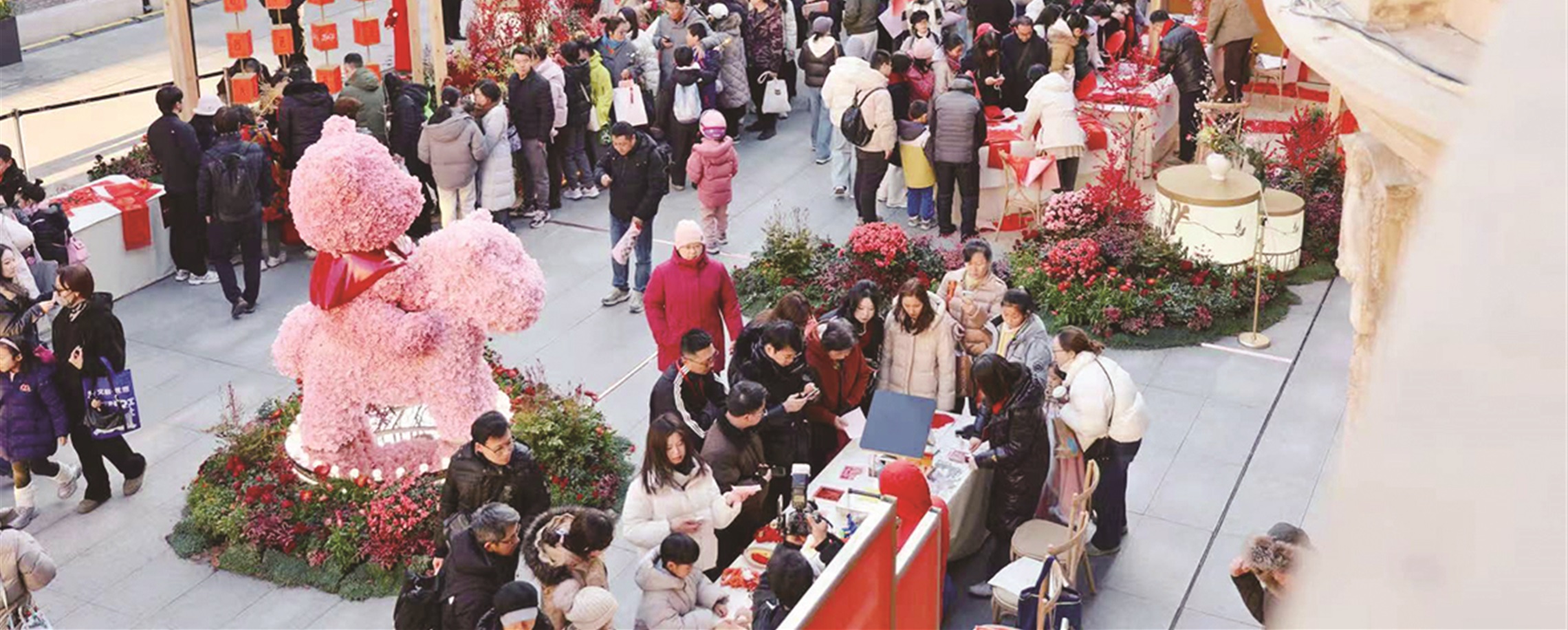
First in Shanghai is our column documenting the rise of Shanghai's "debut economy," a model built on being first, fast, and everywhere at once. What started as a policy initiative has morphed into a citywide phenomenon: part economic strategy, part cultural spectacle. In this series, we explore how brands – both local and global – are choosing Shanghai not just to launch products, but to create moments. It's retail as ritual, commerce as event, and we're here to unpack what it all means.
Walk down Nanjing Road W. these days and you might catch a whiff of saffron drifting out of a newly-opened spice atelier, slip past a soft launch for cycling obsessives on Yongyuan Road, or get nudged out of the way by the selfie stick of someone capturing their first "dumpling bag" moment at Beyond The Vines. Jing'an's sidewalks aren't just busy... they are increasingly becoming a curation of international brands as if some retail demigod had been playing SimCity with an unlimited budget and a weakness for debut fever. In 2026, the neighborhood is rewriting the rulebook for what it means to "open in China," converting first-store announcements into minor civic holidays and making the world's biggest brands fight for a slice of local cool.
In this edition of First in Shanghai, we'll be exploring why Jing'an is topping the charts for foreign brand debuts, how the district became Shanghai's ultimate launchpad, and what these waves of new openings say about changing consumer tastes, government strategy, and the shifting lines between commerce and culture. Along the way, we'll answer the big questions: What makes Jing'an such fertile ground for international brands? How does the local "testbed-launchpad" model actually work in practice? And is this just the beginning, or will the party eventually move on? Let's dig in.
Now, before we get into the deep dive about why Jing'an is a master district for launches, let's go over a few new openings in the district to serve as cases in points.
Let's start with Nanjing Road W.; forever a central nexus of transformation for Shanghai.
New names keep landing here. North America-born activewear brand Alo Yoga, one of the fastest-rising players in fashion-forward sportswear, is set to open its first China store on this very street.
Jing'an, as well, ever a hub of commercial innovation and consumer vitality, is buzzing with energy. Its reputation as a "launchpad for firsts" is attracting pioneering global brands, kicking off the first wave of flagship and debut stores of 2026.
In January 2026, Singapore-based design label Beyond The Vines (BTV) opened its first physical store in China at HKRI Taikoo Hui, marking one of the standout moments in early-year fashion retail.
![[1st in SH] Why Is Jing'An District Killing It With Foreign Brands?](https://obj.shine.cn/files/2026/02/05/d77adfa2-9673-44a2-9fee-befe7189d9d3_0.jpg)
Ti Gong
Exterior of the Beyond The Vines store
Known for its bold colors, clean lines and that now-iconic "dumpling bag," Beyond The Vines makes its China debut as a self-styled "Design Post." The opening lands with a limited-edition collection riffing on traditional Chinese culture – striking just the right note with New Year shoppers hungry for novelty and fresh design language. The result? A vibrant shot of Southeast Asian creativity injected straight into the heart of Jing'an's ever-evolving retail scene.
![[1st in SH] Why Is Jing'An District Killing It With Foreign Brands?](https://obj.shine.cn/files/2026/02/05/2d19b771-7974-442b-933c-ed3ef23124ac_0.jpg)
Ti Gong
Interior layout of the Beyond The Vines store
![[1st in SH] Why Is Jing'An District Killing It With Foreign Brands?](https://obj.shine.cn/files/2026/02/05/b47aaa8d-5c24-42dc-9901-c54b72b76aa2_0.jpg)
Ti Gong
Interior layout of the Beyond The Vines store
We are also seeing professional sports segment openings as being equally impressive. Craft, the Swedish endurance sports brand from Northern Europe, officially opened its first China concept flagship store on January 29.
![[1st in SH] Why Is Jing'An District Killing It With Foreign Brands?](https://obj.shine.cn/files/2026/02/05/7fc5024e-62dd-43b7-8738-5a6b7494bd18_0.jpg)
Ti Gong
Exterior of the Craft store
![[1st in SH] Why Is Jing'An District Killing It With Foreign Brands?](https://obj.shine.cn/files/2026/02/05/af804578-6e88-45ac-b154-a7def1dc6348_0.jpg)
Ti Gong
Interior layout of the Craft store
Similarly, high-performance cycling apparel brand MAAP LaB, founded in Melbourne, Australia, has chosen Yongyuan Road for its first China store.
Guided by its philosophy, "Life Around Bikes," the brand is introducing a professional yet fashion-conscious outdoor sports aesthetic to Shanghai through city-exclusive products and frequent community events – resonating with the growing desire for healthier, more active lifestyles.
![[1st in SH] Why Is Jing'An District Killing It With Foreign Brands?](https://obj.shine.cn/files/2026/02/05/30dcd551-cbd0-4a37-965c-50fd5c07fb66_0.jpg)
Ti Gong
Exterior of the MAAP LaB store
From Saudi Arabia, spice brand Revanna opened its first offline experiential space in Shanghai during the New Year period, selecting the historic streetscape of Julu Road as its location.
Renowned for its fragrance maturation process that lasts over 100 days, the brand aims to create a sensory landmark that can be experienced only here. By choosing Julu Road, Revanna places Eastern incense traditions and Middle Eastern spice culture into a shared dialogue, offering consumers a cultural experience that goes beyond material consumption.
![[1st in SH] Why Is Jing'An District Killing It With Foreign Brands?](https://obj.shine.cn/files/2026/02/05/fdbd8c58-d01b-4cef-ad76-eb6d5f90656d_0.jpg)
Ti Gong
Exterior of the Revanna store
![[1st in SH] Why Is Jing'An District Killing It With Foreign Brands?](https://obj.shine.cn/files/2026/02/05/48fc9977-4429-4d0b-87e1-09fad33dd960_0.jpg)
Ti Gong
Perfumes adorn one of the walls Revanna
Food and beverage debut stores are no less competitive. Popular among Gen Z, dessert brand Naruroo Soufflé has opened its first Shanghai store at Réel department store.
Its signature freshly baked soufflés are light, airy and cloud-like. These little treats deliver both visual delight and comfort on the palate, which has converted into quickly winning over office workers and young consumers in the area. Beyond enriching the dining options along Nanjing Road W., the brand's "slow-down" dessert philosophy speaks directly to the craving for everyday moments of joy and a renewed sense of well-being.
![[1st in SH] Why Is Jing'An District Killing It With Foreign Brands?](https://obj.shine.cn/files/2026/02/05/707020d0-d0fd-4afe-8987-3ab48f2c6a07_0.jpg)
Ti Gong
Poster for Naruroo Soufflé
This highly-concentrated and diverse wave of new store openings is underpinned by Jing'an District's long-term commitment to the "debut economy," which has fostered a distinctive commercial ecosystem. This momentum is no coincidence, but the result of a systematic, strategic approach.
First, it is rooted in a mature "main-street, back-street" collaborative structure. Nanjing Road W., anchored by landmarks such as Plaza 66 and HKRI Taikoo Hui, continues to attract international, image-driven, high-level debut stores like Beyond The Vines and Craft.
At the same time, back streets such as Julu Road and Yongyuan Road, with their open, artistic and relaxed neighborhood atmosphere, provide ideal ground for brands like Revanna and MAAP – labels that emphasize cultural storytelling, community engagement and lifestyle expression – to establish experiential first stores. This layered and complementary urban structure offers brands at different stages and with different identities precisely matched spatial choices.
![[1st in SH] Why Is Jing'An District Killing It With Foreign Brands?](https://obj.shine.cn/files/2026/02/05/2a05e74d-194d-43a9-8845-56edbc833b03_0.jpg)
Ti Gong
Labelhood House on Julu Road
Second, Jing'an offers a replicable, low-risk pathway for international brands entering China. The district has developed a mature "testbed-launchpad" model, allowing brands to test the market, gather feedback, build awareness and ultimately establish a stable, strategic presence. This approach significantly reduces the risks traditionally associated with market entry and first-store launches.
![[1st in SH] Why Is Jing'An District Killing It With Foreign Brands?](https://obj.shine.cn/files/2026/02/05/240c25d8-2eb5-4707-8a04-a4bb1f5ff26f_0.jpg)
Ti Gong
Street view of Yongyuan Road
![[1st in SH] Why Is Jing'An District Killing It With Foreign Brands?](https://obj.shine.cn/files/2026/02/02/68bf3b96-d8f3-4c39-89cf-2a8dbbc5af60_0.jpg)
Ti Gong
adidas Originals pop-up activation on Yongyuan Road
Over the past five years, Jing'an has attracted 1,186 first stores. In 2023, 236 international first stores opened here, followed by 234 in 2024 and another 88 in the first half of 2025. Today, over 2,000 brands – more than 70 percent of them international – are concentrated within the 1.8-square-kilometer Nanjing Road W. area, Zhong Xiaoyong, Party secretary of Jing'an District, said in a recent interview with CCTV.com.
A key driver of this development is Zhangyuan, Shanghai's largest preserved shikumen (stone-gated houses) complex, which has emerged as a new landmark for the debut economy.
Phase One has already attracted more than 30 international flagship first stores. Phase Two, currently under construction, will add over 40,000 square meters by the end of next year, creating expanded space for first shows, exhibitions and brand activations.
![[1st in SH] Why Is Jing'An District Killing It With Foreign Brands?](https://obj.shine.cn/files/2026/02/02/e5c614df-f307-492e-b6f5-eb8bf48b4af6_0.jpg)
Ti Gong
![[1st in SH] Why Is Jing'An District Killing It With Foreign Brands?](https://obj.shine.cn/files/2026/02/11/c2938056-900a-4cf8-9282-78c6679a90c6_0.png)
Ti Gong
Inside the Dior pop-up at Zhangyuan
![[1st in SH] Why Is Jing'An District Killing It With Foreign Brands?](https://obj.shine.cn/files/2026/02/02/3fbd82a6-276b-4ad0-a026-c736a3d032fa_0.jpg)
Ti Gong
Zhangyuan has become a runway for major brands in the Nanjing Road W. area.
Institutional support has played a critical role in enabling first launches. The number of tax refund outlets along Nanjing Road W. has increased from 60-70 to nearly 500, with the potential to reach 1,000 in 2025, significantly improving convenience for overseas shoppers.
Within the highly valuable space of Zhangyuan, over 200 square meters were set aside to create a compact bonded warehouse – the first such facility within a central-city commercial district. Despite its small scale, the bonded warehouse allows international brands to bring in their most representative and refined products for debut displays.
![[1st in SH] Why Is Jing'An District Killing It With Foreign Brands?](https://obj.shine.cn/files/2026/02/02/277d1d71-7ef9-4793-a3f2-60c812d9518c_0.png)
Ti Gong
An expat completing tax-refund procedures at the Zhangyuan departure tax-refund counter.
Consumption in Jing'an is increasingly experience-driven. As expectations shift from price to emotional and cultural value, simply introducing products to China is no longer enough. Today's consumers – especially younger generations – seek immersive experiences and cultural resonance, pushing international brands to connect with the local market in more meaningful ways. The immersive productions such as Sleep No More, which has staged over 2,200 performances, along with newer shows like SIX and Arcane introduced in 2025, reflect this shift.
![[1st in SH] Why Is Jing'An District Killing It With Foreign Brands?](https://obj.shine.cn/files/2026/02/02/cd38649f-7810-42d8-96b3-86fdb137cca7_0.png)
Ti Gong
![[1st in SH] Why Is Jing'An District Killing It With Foreign Brands?](https://obj.shine.cn/files/2026/02/02/5cb2effb-deab-4045-812f-4a85079dd086_0.png)
Ti Gong
![[1st in SH] Why Is Jing'An District Killing It With Foreign Brands?](https://obj.shine.cn/files/2026/02/02/a9b868a4-44cd-4d78-9402-6fc837978d82_0.jpg)
Ti Gong
Sleep No More experience at Zhangyuan
At the governance level, Jing'an emphasizes proactive, service-oriented administration, coordinating closely with municipal authorities to balance regulatory requirements with cultural and commercial innovation. The rapid approval and implementation of large-scale exhibitions demonstrate how an optimized business environment can translate creative concepts into tangible economic impact.
For example, the Louis Vuitton ship exhibition, The Louis, drove a 10 percent year-on-year increase in total spending across Nanjing Road W. Nearby Starbucks outlets recorded sales growth of 30-40 percent, while overall consumption at HKRI Taikoo Hui more than doubled. At peak periods, foot traffic reached four times normal levels, and even after the event, average daily footfall remained about 100 percent higher than before.
Overall, Jing'an's first-store economy is not solely about attracting new brands, but about shaping consumption standards, defining premium value, and reinforcing Nanjing Road W.'s position as a benchmark for international consumption in Shanghai.
![[1st in SH] Why Is Jing'An District Killing It With Foreign Brands?](https://obj.shine.cn/files/2026/02/02/db2676d8-d0a0-41df-be5a-13fccd1f40c8_0.jpg)
Ti Gong
Aerial view of the The Louis
![[1st in SH] Why Is Jing'An District Killing It With Foreign Brands?](https://obj.shine.cn/files/2026/02/02/e5c64096-27a3-4688-a89c-957eabd2d9f2_0.jpg)
Ti Gong
A foreign visitor posing for photos beside the The Louis.
![[1st in SH] Why Is Jing'An District Killing It With Foreign Brands?](https://obj.shine.cn/files/2026/02/02/3ea0c8a9-1c8c-46a0-87be-1a8dec25fa4a_0.jpg)
Ti Gong
Tourists posing with LinaBell by the The Louis












![[1st in SH] Why Is Jing'An District Killing It With Foreign Brands?](https://obj.shine.cn/files/2026/02/02/e83d57f9-3bdf-4591-aad8-50f4e32f3d1e_0.jpg)







 2026-02-24