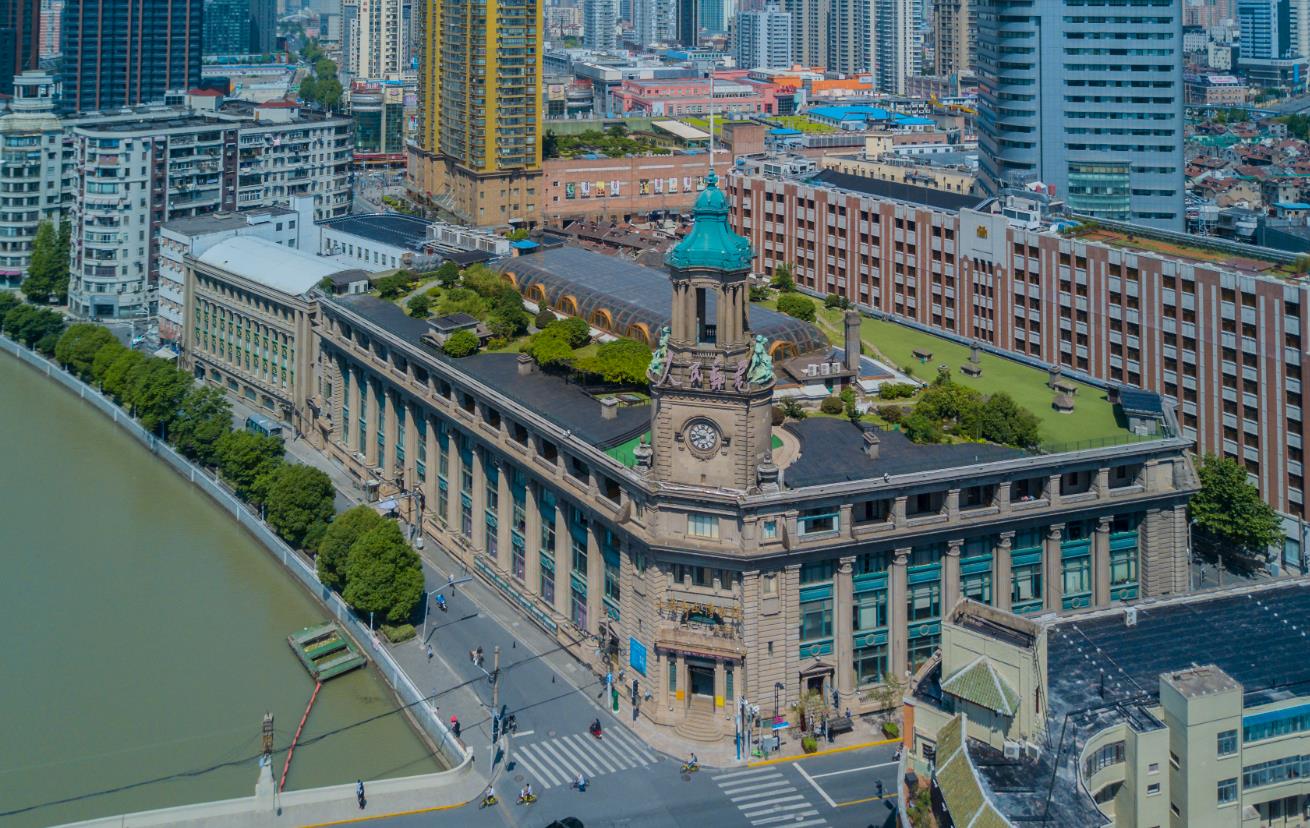
The Shanghai Postal Museum is the earliest and largest postal building in China. It is also a symbol of modern Chinese postal services. Covering an area of 6,400 square meters, it was completed and put into use in 1924. Designed by British architect R S Stewardson, it was constructed by the Chinese firm Yuhongji Construction Company. The scale of the building was the largest in the postal industry in Asia at that time, with grand and magnificent stone columns and cement sculptures that reflected the style of classical British architecture.
The building has a "U" shaped floor plan, with the main building being 4 stories high and an additional basement level. At the corner, there is an Italian Baroque-style clock tower popular in the 16th century, with a tower on top. The most eye-catching feature is the two groups of statues on the base of the clock tower, symbolizing the development of transportation and postal services. One group consists of 3 people holding a train head, an anchor, and communication cables. The other group also consists of 3 people, with the Greek god Mercury in the middle representing commerce, and love gods on the sides symbolizing the role of postal services in human communication and emotions.
The interior decoration is magnificent, with the entrance hall paved with marble and the floors of other levels using mosaic, terrazzo, and cement. The interior space is spacious and well-lit, with exquisitely designed marble spiral staircases and mail slides. The business hall inside the building covers an area of 1,200 square meters, integrating business, sorting, delivery, and transportation. It is known as the "First Postal Hall in the Far East."
In 2002, the second floor of the Shanghai Postal Headquarter was transformed into the "Shanghai Postal Museum," with the museum name inscribed by Jiang Zemin. As the first specialized postal museum in the country, the Shanghai Postal Museum uses detailed historical materials and artifacts, as well as modern technology, to trace the origin and development of postal services, documenting the early party organizations' leadership of workers' movements and the contributions of revolutionary predecessors to the birth of New China. Today, this building has become a landmark in the field of postal services, representing the earliest and largest postal architectural construction in use in China, and serving as a witness to the postal history of Shanghai and even China.



















 2026-05-28